Tésamoréline
Tesamorelin (analogue synthétique de la GHRH)
Tesamorelin is a synthetic analogue of GHRH (Growth Hormone Releasing Hormone) that naturally stimulates the secretion of growth hormone (GH) by the pituitary gland, promoting a targeted reduction in visceral fat and an overall improvement in body composition.
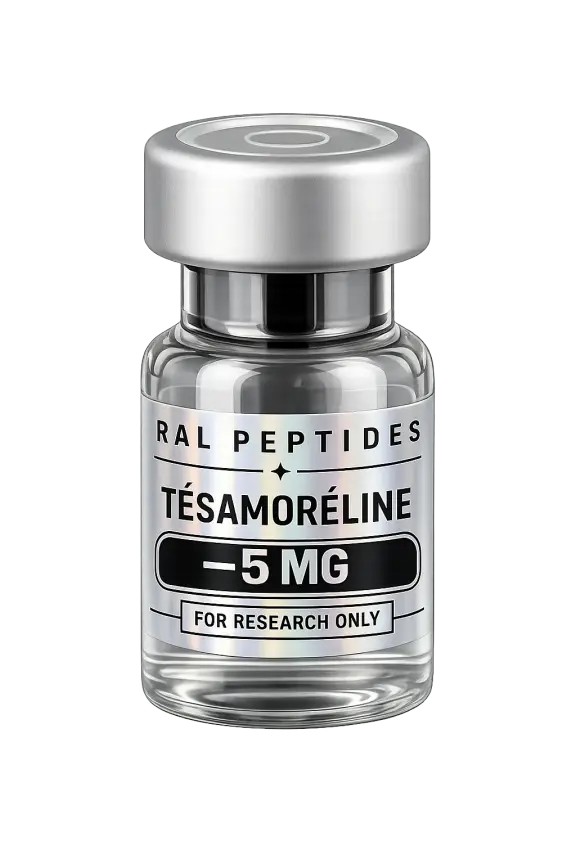
Chemical identity
- Sequence
- YADAIFTNSYRKVLGQLSARKLLQDIMSRQQGESNQERGARARL (analogue GHRH 1-44, C-term amidé)
- Molecular formula
- C221H366N72O67S
- Molecular weight
- 5135.76 g/mol
- CAS no.
- 218949-48-5
Purity (HPLC) measures the absence of related impurities; it is distinct from net peptide content, since salts and counter-ions (acetate, TFA) count toward the vial mass. Account for this when computing the real concentration at reconstitution.
Potential benefits
Abdominal fat reduction
Targets visceral fat for a leaner silhouette and a significant decrease in deep abdominal fat.
GH stimulation
Naturally increases the pulsatile secretion of growth hormone while respecting physiological rhythms.
Metabolic improvement
Improves metabolism and promotes the use of fat as an energy source.
Body composition
Improves the lean mass / fat mass ratio and preserves lean mass even in a caloric deficit.
Muscle definition
Promotes better definition and preserves lean mass for a leaner physique.
Performance
Optimizes energy, recovery, and overall performance.
Mechanism of action
- Hypothalamic stimulation: Tesamorelin mimics GHRH and stimulates the hypothalamus.
- Pituitary stimulation: increases the pulsatile secretion of GH by the pituitary gland.
- GH release: GH is released into the blood in a physiological, pulsatile manner.
- Peripheral action: GH acts on metabolism, promoting lipolysis and the preservation of lean mass.
- IGF-1 production: the liver produces IGF-1 in response to GH, amplifying its anabolic and metabolic effects.
Historical milestones
Research milestones, clinical trials and regulatory steps.
- 2000s
GHRH analog TH9507
Theratechnologies develops tesamorelin, a 44-amino-acid GH-releasing factor modified with a hexenoyl group to extend its stability.
- 2007
Phase 3 results
Falutz and colleagues report in the NEJM a marked reduction in visceral fat in HIV patients on antiretroviral therapy.
- 2010
FDA approval (EGRIFTA)
On 10 November 2010 the FDA approves EGRIFTA, the first treatment for HIV-associated lipodystrophy with excess abdominal fat.
- 2025
New EGRIFTA WR formulation
In March 2025 the FDA approves the F8 formulation (EGRIFTA WR), more concentrated and easier to reconstitute.
Evolution over time
Gradual improvement in energy, recovery, and sleep quality.
Better insulin sensitivity, increased fat oxidation, and improved blood glucose management.
Visible decrease in visceral fat, reduced waist circumference, and better muscle definition.
Lasting body recomposition, preservation of lean mass, and overall improvement in metabolic health.
Dosages & protocol
Reference dosages
12 wk
In the evening, 30 to 60 minutes before bedtime (on an empty stomach or after a light meal)
Very short plasma half-life (roughly 8-38 minutes); the GH and IGF-1 rise it triggers lasts far longer, which is why it is dosed daily.
Tesamorelin vs GHRP
Tesamorelin favors a clean, physiological, and lasting stimulation, with a specific impact on visceral fat and metabolic health.
- Stimulates GH release in a physiological way, without increasing appetite.
- Increases GH and IGF-1 with a cleaner action and fewer side effects.
- Ideal for visceral fat reduction and metabolic health.
- GHRP strongly stimulates GH (via ghrelin) but can increase appetite and targets visceral fat less.
Recommended dilution (10 mg vial)
Concentrations obtained according to the volume of bacteriostatic water added (U-100 syringe).
- 1 ml of BAC → 10 mg/ml → 100 mcg per unit.
- 2 ml of BAC → 5 mg/ml → 50 mcg per unit.
- 3 ml of BAC → 3.33 mg/ml → 33 mcg per unit.
- 4 ml of BAC → 2.5 mg/ml → 25 mcg per unit.
Required equipment & best practices
- Vial of lyophilized Tesamorelin (10 mg) and bacteriostatic water (BAC).
- Sterile syringes (1 ml / 0.5 ml) and injection needles (29G-31G).
- Alcohol swabs and a sharps container.
- Inject at 90° (or 45° if very lean), slowly and without rubbing, then immediately dispose of needles in a suitable sharps container.
- Never leave at room temperature and keep out of reach of children.
Usage tips
- Start low, go slow, and increase the dose gradually.
- Assess individual response and adjust based on results and goals.
- Store the reconstituted solution in the refrigerator (2-8°C) and use within 20 to 30 days.
- Always use sterile technique and clean, disinfected equipment.
- Do not inject at the same site twice in the same day; rotate between abdomen, thighs, glutes, or upper arms.
- Combine with a suitable diet and consistent training; consistency and discipline are the keys to success.
Good to know / effects to watch
- Studies on GHRH analogues report arthralgia (joint pain) and peripheral edema.
- Paresthesia (tingling, numbness in the extremities) may be observed.
- Redness, itching, or discomfort at the injection site.
- Headaches reported within the class.
- Possible impact on insulin sensitivity and blood glucose: to be monitored.
- Known hypersensitivity to Tesamorelin or any of its excipients: to be avoided. Consult a healthcare professional if in doubt.
- Pregnancy, breastfeeding, and a history of GH-sensitive tumors: caution advised; consult a healthcare professional if in doubt.
Storage
- Before reconstitution: store the lyophilized powder refrigerated (2-8 °C), protected from light.
- After reconstitution: keep refrigerated (2-8 °C) and use within the recommended window (bacteriostatic-water preparations keep cold for up to ~28 days).
- Do not freeze the reconstituted solution; protect it from light.
Contraindications
- Pregnancy: contraindicated (animal teratogenicity including hydrocephaly). Breastfeeding: avoid.
- Active malignancy: contraindicated; any preexisting tumor must be inactive and treated before use.
- Disruption of the hypothalamic-pituitary axis (hypophysectomy, hypopituitarism, pituitary surgery/radiation/trauma): contraindicated.
- Active proliferative diabetic retinopathy; diabetes: monitor blood glucose (GH class effect).
- Known hypersensitivity to tesamorelin or mannitol; not advised in children.
Possible synergistic combinations
The catalog peptides are clickable — to complete or optimize your protocol.
May potentiate the effects on GH secretion.
View the sheet & add →Possible synergy on growth hormone release.
Synergy to maximize body recomposition and metabolic health.
Sources & references
Links to external sources (scientific databases, trial registries, authorities). RAL Peptides is not responsible for their content.
Featured in these stacks
⚠ For research use only. NOT intended for use on humans or animals. The values shown are indicative and for informational purposes ; each person reacts differently. This guide does not replace medical advice — consult a healthcare professional if in doubt.