CJC-1295 (sans DAC)
Analogue de la GHRH — Mod GRF (1-29)
CJC-1295 without DAC, also known as Mod GRF (1-29), is a short-acting GHRH (growth hormone-releasing hormone) analog. It stimulates the pituitary gland to induce a natural pulse of GH secretion, followed by a rise in IGF-1, while respecting physiological pulsatility. Its short half-life makes it particularly well suited to pairing with a GHRP such as Ipamorelin, whose action is complementary.
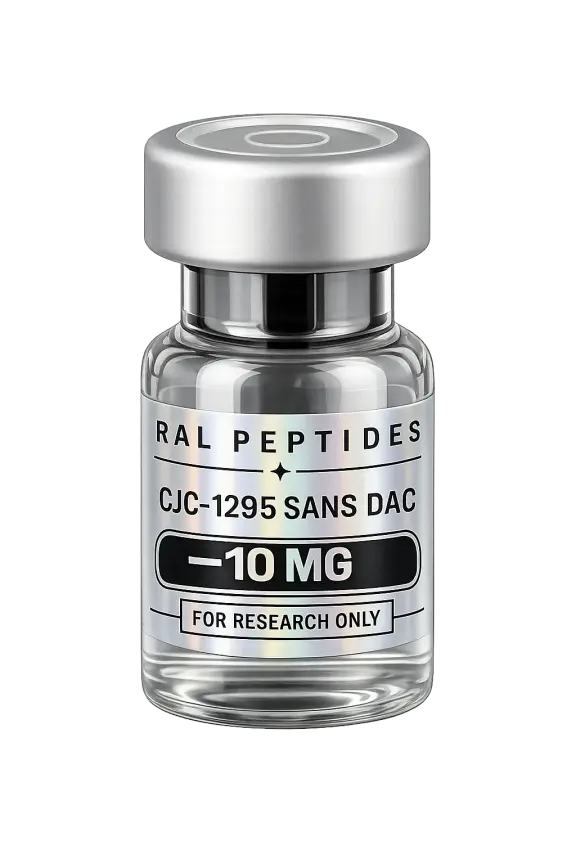
Chemical identity
- Sequence
- YADAIFTQSYRKVLAQLSARKLLQDILSR (Mod GRF 1-29, sans DAC ; D-Ala2, C-term amidé)
- Molecular formula
- C152H252N44O42
- Molecular weight
- 3367.9 g/mol
- CAS no.
- 863288-34-0
Purity (HPLC) measures the absence of related impurities; it is distinct from net peptide content, since salts and counter-ions (acetate, TFA) count toward the vial mass. Account for this when computing the real concentration at reconstitution.
Potential benefits
GH pulse
Promotes a pulsatile, physiological release of growth hormone from the pituitary gland.
GHRP synergy
Pairs naturally with a GHRP (e.g. Ipamorelin) for an amplified GH response.
Recovery
Supports tissue repair and recovery after exercise.
Sleep
May contribute to deeper sleep, a key phase for GH secretion.
Body composition
Helps, via the rise in IGF-1, preserve lean mass and mobilize fat.
Preserved pulsatility
Its short duration of action limits receptor saturation and preserves the natural GH rhythm.
Mechanism of action
- Binds to GHRH receptors on the pituitary gland to trigger a pulse of growth hormone secretion.
- Leads to a secondary rise in IGF-1, a mediator of tissue regeneration and protein synthesis.
- Acts via a distinct but complementary pathway to GHRPs (ghrelin receptor), producing strong synergy with Ipamorelin.
- Its "without DAC" form (Mod GRF 1-29) has a short half-life, producing a brief peak close to natural physiological release.
- Respecting pulsatility limits desensitization and favors a hormonal profile close to normal function.
Historical milestones
Research milestones, clinical trials and regulatory steps.
- 2000s
Development at ConjuChem
Montreal-based ConjuChem designs CJC-1295 from a stabilized tetra-substituted GHRH (1-29), coupled to its albumin-binding DAC technology.
- 2005
Long-acting analog
The DAC version greatly extends half-life, while the no-DAC form (Mod GRF 1-29) remains short-acting.
- 2006
Phase 1/2 clinical trial
Teichman and colleagues report in JCEM a prolonged rise in GH and IGF-1 in healthy adults after a single dose.
- 2026
Never approved
Clinical development did not proceed and CJC-1295 has received no regulatory approval, remaining a research peptide.
Evolution over time
Often deeper sleep and a sense of better recovery from training.
Faster muscle recovery, more stable energy, reduced soreness.
Progressive optimization of body composition and tissue regeneration.
Established benefits for recovery and vitality, more lasting results.
Dosages & protocol
Reference dosages
12 wk + 4 off
On an empty stomach, generally before bedtime and/or around training, 1 to 3 doses per day
Very short (~30 minutes) for the no-DAC form (Mod GRF 1-29) — hence daily dosing and pairing with a GHRP.
What it is not
- It is not a steroid.
- It is not exogenous GH: it stimulates endogenous production.
- It is not a direct fat burner.
- It is not a miracle product: it is described as amplifying effort, not replacing it.
Without DAC vs. with DAC
- The "without DAC" version (Mod GRF 1-29) has a short half-life and generates a brief peak, close to the natural rhythm.
- The "with DAC" version has a long half-life and maintains an elevated GH level over several days.
- The without-DAC format is preferred to respect physiological pulsatility and to combine with a GHRP.
Recommended dilution (10 mg vial, U-100 syringe)
- 1 ml of BAC → 10 mg/ml → 100 mcg per unit.
- 2 ml of BAC → 5 mg/ml → 50 mcg per unit.
- 3 ml of BAC → 3.33 mg/ml → 33 mcg per unit.
- 4 ml of BAC → 2.5 mg/ml → 25 mcg per unit.
Usage tips
- Inject on an empty stomach: an insulin or carbohydrate spike blunts the GH response.
- Combine with a GHRP such as Ipamorelin to maximize the GH pulse.
- Favor a dose before bedtime to align with the nocturnal GH peak.
- Wait 20-30 minutes before eating after the injection.
- Start low, go slow, and maintain good sleep hygiene.
Good to know / effects to watch
- Mild, transient water retention possible.
- Drowsiness or fatigue, especially after the evening injection.
- Hot flushes / flushing and transient tingling sensation.
- Redness or discomfort at the injection site.
- Known hypersensitivity to the product or any of its excipients: to be avoided.
- Pregnancy, breastfeeding, and history of GH-sensitive tumors: caution advised. Consult a healthcare professional if in doubt.
Storage
- Before reconstitution (lyophilized powder): refrigerated (2-8 °C), away from light; tolerates short periods at room temperature during shipping.
- After reconstitution: refrigerated (2-8 °C), typically use within ~2 to 4 weeks (GHRH peptide is more fragile in solution).
- Do not freeze the reconstituted solution, do not shake vigorously, avoid heat and direct light.
Contraindications
- Pregnancy and breastfeeding: avoid.
- Active cancer or history of GH/IGF-1-sensitive tumors: contraindication.
- Diabetes or insulin resistance: caution (GH can raise blood glucose).
- Known hypersensitivity to the product or any excipient; do not use in minors (growth).
- Research peptide never approved: human use not validated.
Possible synergistic combinations
The catalog peptides are clickable — to complete or optimize your protocol.
Reference combination: the GHRP amplifies the GH pulse triggered by the GHRH, a synergistic effect.
View the sheet & add →Another possible GHRP for synergy on GH release (also stimulates appetite).
Sources & references
Links to external sources (scientific databases, trial registries, authorities). RAL Peptides is not responsible for their content.
⚠ For research use only. NOT intended for use on humans or animals. The values shown are indicative and for informational purposes ; each person reacts differently. This guide does not replace medical advice — consult a healthcare professional if in doubt.