Ipamorelin
Peptide mimétique de la ghréline (GHS-R)
Ipamorelin is a ghrelin-mimetic peptide that selectively and physiologically stimulates the pituitary gland's secretion of growth hormone (GH), without significantly raising cortisol, prolactin, or appetite. It supports recovery, improves sleep, and promotes optimal body composition.
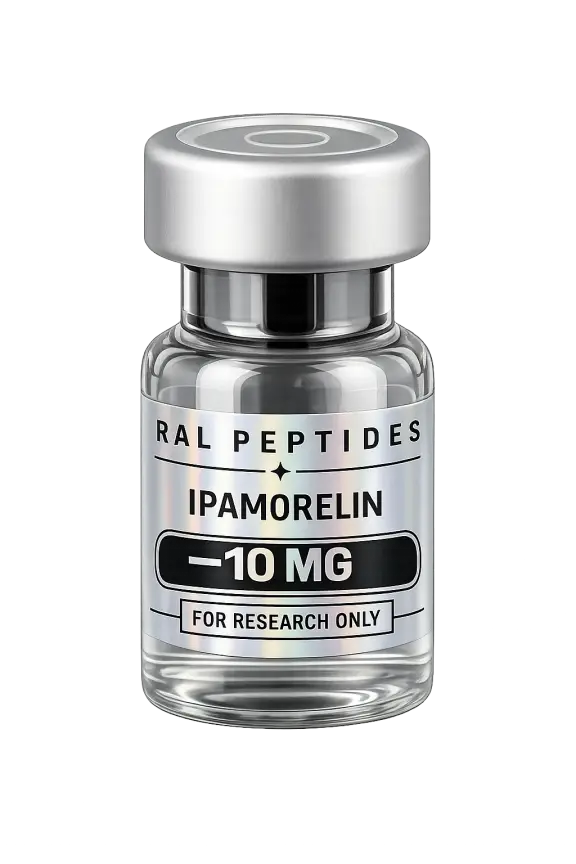
Chemical identity
- Sequence
- Aib-His-D-2-Nal-D-Phe-Lys-NH2
- Molecular formula
- C38H49N9O5
- Molecular weight
- 711.9 g/mol
- CAS no.
- 170851-70-4
Purity (HPLC) measures the absence of related impurities; it is distinct from net peptide content, since salts and counter-ions (acetate, TFA) count toward the vial mass. Account for this when computing the real concentration at reconstitution.
Potential benefits
Deep sleep
Improves the quality and duration of deep sleep (stages 3 & 4), essential for regeneration.
Muscle recovery
Speeds up fiber repair and reduces post-workout soreness.
Regeneration
Stimulates cellular repair and tissue regeneration.
Performance
Optimizes recovery and improves physical capacity.
Body composition
Helps reduce fat mass while preserving lean mass.
Anti-catabolic
Prevents muscle breakdown and supports optimal anabolism.
Mechanism of action
- Stimulates the pituitary gland's ghrelin receptors (GHS-R) to induce a physiological, pulsatile release of GH.
- Stimulates IGF-1 production, a key factor in regeneration and protein synthesis.
- Promotes cellular growth and nerve and muscle recovery.
- Improves deep sleep quality, the phase during which most GH is released.
- Contributes to better fat utilization as an energy source, without stimulating appetite.
Historical milestones
Research milestones, clinical trials and regulatory steps.
- 1998
First selective GH secretagogue
Raun and colleagues at Novo Nordisk describe ipamorelin, a pentapeptide derived from GHRP-1, in the European Journal of Endocrinology.
- 1998
Pharmacological selectivity shown
Preclinical work shows GH release without meaningful rises in ACTH, cortisol or prolactin, unlike earlier GHRPs.
- 2000s
Clinical gut-motility exploration
The compound is tested in Phase 2 trials as a motility agonist, notably for post-operative ileus, without reaching approval.
- 2026
Current status
Ipamorelin remains a research compound, not approved as a drug by the FDA or EMA.
Evolution over time
Easier falling asleep, slightly deeper sleep, fewer nighttime awakenings.
Longer deep sleep, faster muscle recovery, less soreness, increased morning energy.
Overall sleep optimization, faster full recovery, progressing performance.
Optimal regeneration established, improved overall vitality, lasting results.
Dosages & protocol
Reference dosages
12 wk + 4 off
Before bedtime (fasted or after a light meal), 1 to 3 injections per day
Short plasma half-life of about 2 hours; near-complete clearance within 4-6 hours of subcutaneous injection.
What it is not
- It is not a steroid.
- It is not a direct fat burner.
- It is not a substitute for a healthy, balanced diet.
- It is not a miracle product: Ipamorelin is described as amplifying effort, not replacing it.
Who is Ipamorelin for?
- People looking to improve their sleep quality
- Athletes seeking better recovery
- People aiming to reduce fat mass
- People wishing to preserve or increase lean muscle mass
- People in a caloric deficit
Recommended dilution (10 mg vial, U-100 syringe)
- 1 mL of BAC → 10 mg/mL → 100 mcg per unit.
- 2 mL of BAC → 5 mg/mL → 50 mcg per unit.
- 3 mL of BAC → 3.33 mg/mL → 33 mcg per unit.
- 4 mL of BAC → 2.5 mg/mL → 25 mcg per unit.
Usage tips
- Preferably inject before bedtime (fasted or after a light meal) to maximize the nighttime GH peak.
- Maintain a regular sleep routine and limit blue light exposure in the evening.
- Ensure sufficient protein intake throughout the day.
- Start low, go slow, increase gradually.
- Avoid combining with substances that raise cortisol.
Good to know / effects to watch
- Studies on GH secretagogues report water retention and mild edema, often transient.
- May be observed: tingling or numbness in the extremities (a pattern resembling carpal tunnel syndrome).
- Fatigue or drowsiness, particularly after the evening injection.
- Increased appetite linked to activation of the ghrelin pathway.
- Redness or local discomfort at the injection site.
- Caution regarding blood glucose: a transient decrease in insulin sensitivity is described for this class. Known hypersensitivity to the product: to be avoided.
- Pregnancy, breastfeeding, and a history of GH-sensitive tumors: caution advised; consult a healthcare professional if in doubt.
Storage
- Before reconstitution: store the lyophilized powder refrigerated (2-8 °C) or frozen (-20 °C), protected from light and moisture (stable for months to over a year).
- After reconstitution: keep refrigerated (2-8 °C) and use within ~28 days.
- Do not freeze the reconstituted solution; protect it from light and do not leave it at room temperature.
Contraindications
- Pregnancy and breastfeeding: avoid as a precaution (no human data).
- History of cancer or active tumor, especially GH/IGF-1-sensitive: avoid, seek medical advice.
- Diabetes or insulin resistance: monitor blood glucose (possible reduced insulin sensitivity, a GH-secretagogue class effect).
- Proliferative diabetic retinopathy: caution (GH-class effect).
- Known hypersensitivity to the product; not advised in children and adolescents. Unapproved research compound (FDA/EMA).
Possible synergistic combinations
The catalog peptides are clickable — to complete or optimize your protocol.
May potentiate effects on GH secretion.
View the sheet & add →Possible synergy on growth hormone release.
Sources & references
Links to external sources (scientific databases, trial registries, authorities). RAL Peptides is not responsible for their content.
Featured in these stacks
⚠ For research use only. NOT intended for use on humans or animals. The values shown are indicative and for informational purposes ; each person reacts differently. This guide does not replace medical advice — consult a healthcare professional if in doubt.