TB-500
fragment synthétique de la Thymosine Bêta-4
TB-500 (a synthetic fragment of Thymosin Beta-4) is a peptide naturally present in the human body. It plays a key role in cellular regeneration, tissue repair, inflammation reduction, and improved mobility. It is a synthetic fragment of Thymosin Beta-4, a protein naturally present in the body, widely used to speed up recovery, reduce inflammation, and improve mobility. The literature describes it as a support for recovery and performance.
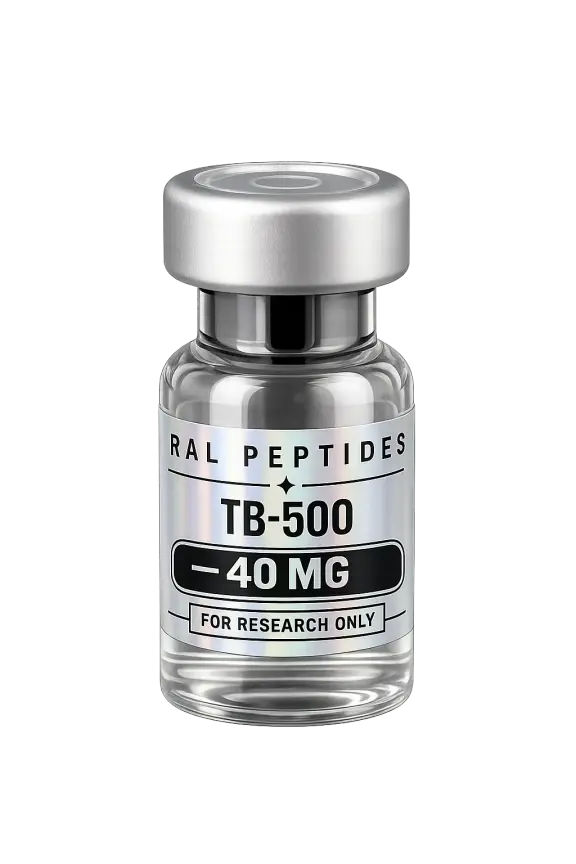
Chemical identity
- Sequence
- LKKTETQ (Ac-LKKTETQ, AA 17-23 de la thymosine β4)
- Molecular formula
- C38H68N10O14
- Molecular weight
- 889.02 g/mol
- CAS no.
- 885340-08-9
Purity (HPLC) measures the absence of related impurities; it is distinct from net peptide content, since salts and counter-ions (acetate, TFA) count toward the vial mass. Account for this when computing the real concentration at reconstitution.
Potential benefits
Wound healing
Speeds up the healing of injuries (muscle, tendon, ligament, bone).
Anti-inflammatory
Reduces pain and inflammation.
Joint mobility
Improves joint mobility and flexibility.
Recovery
Promotes recovery after intense training or an injury.
Tendon health
Supports tendon and joint health, and tissue healing.
Prevention & performance
May help prevent injuries and improves physical performance.
Mechanism of action
- Cell migration: promotes the movement of cells (fibroblasts, endothelial cells, stem cells) toward injured/damaged areas.
- Angiogenesis: stimulates the formation of new blood vessels to improve oxygen and nutrient supply.
- Inflammation reduction: lowers the production of inflammatory cytokines and speeds up resolution.
- Tissue repair: accelerates the regeneration of muscles, tendons, ligaments, skin, and organs.
- Cellular protection: protects cells against oxidative stress, apoptosis, and free-radical damage.
Historical milestones
Research milestones, clinical trials and regulatory steps.
- 1960s
Isolation of thymosin
Allan Goldstein and colleagues isolate thymosin fractions from thymus extracts, containing what would become Thymosin Beta-4.
- 1981
Full Tβ4 sequence published
Low, Hu and Goldstein publish in PNAS the complete sequence of Thymosin Beta-4, a 43-amino-acid peptide.
- 1990s
Cytoskeletal role identified
Safer, Goldstein and colleagues identify Tβ4 as the major G-actin sequestering agent, explaining its role in cellular repair.
- 2000s
Emergence of the TB-500 fragment
RegeneRx's clinical development of Tβ4 is paralleled by research use of the synthetic fragment TB-500 (sequence LKKTETQ).
- 2012
Analytical characterization
Esposito and colleagues formally characterize TB-500 as a defined synthetic compound, distinct from full-length Tβ4.
- 2010s-2020s
Clinical trials of Tβ4
Tβ4 (RGN-259) reaches phase 2/3 trials for dry eye and neurotrophic keratopathy, while TB-500 itself has no human clinical trial.
Evolution over time
Reduced inflammation and pain. Slightly improved sense of mobility.
Improved mobility and onset of tissue repair.
Visible tissue regeneration and improved performance. Marked reduction in pain.
Optimal recovery and strengthening of tissues and tendons. Better resilience to injury.
Dosages & protocol
Reference dosages
6 wk + 4 off
After training or before bed
Short plasma half-life (estimated 30-60 min in animal models); tissue effects persist for several days, hence the spaced-out injection schedule.
Titration protocol
Stay on one step and let natural accumulation work. Progress slowly.
What is TB-500?
TB-500 is a synthetic fragment of Thymosin Beta-4, a protein naturally present in the human body, involved in tissue repair and regeneration.
- Origin: fragment of a natural human protein (Thymosin Beta-4).
- Main function: tissue repair and regeneration.
- Form: lyophilized (powder).
- Molecular weight: ~ 4966 Da.
- Sequence: AcSDKPDMAEIEKFDKSKLKKTETQEKNPLPSKETIEEQKQAGES.
Areas and targets of action
TB-500 acts on many tissues and systems.
- Musculoskeletal system: muscles, tendons, ligaments, fascia, and joints (shoulders, knees, ankles, back).
- Skin & soft tissue: improves healing of wounds, burns, and skin lesions.
- Cardiovascular system: formation of new vessels and tissue repair.
- Nervous system: promotes nerve regeneration and recovery after injury.
- Common applications: sports injuries, post-surgical recovery, tendinitis, rehabilitation.
- General health: improves resilience to physical and inflammatory stress.
Research protocol rationale
- Start at the lowest effective dose, adjusted according to individual response.
- General recovery: 2 mg, 2 to 3 times / week over 4 to 6 weeks.
- Acute injuries or post-surgical: 2 to 2.5 mg, 2 to 3 times / week over 6 to 12 weeks.
- Standard cycle: 4 to 6 weeks of use then 2 to 4 weeks off.
- Consistency matters more than high frequency.
Optimizing recovery
The effects of TB-500 are described as optimized by a comprehensive approach.
- Quality sleep: 7 to 9 hours per night to optimize tissue regeneration.
- Suitable nutrition: protein, collagen, omega-3s, vitamins, and minerals.
- Optimal hydration to support healing and tissue elasticity.
- Adapted training: progressive loading, stretching, and targeted strengthening.
- Stress management: lowering cortisol to promote regeneration.
Usage tips
- Protocols describe starting at the lowest effective dose, adjusted according to individual response.
- The literature describes cycling with 4 to 6 week breaks.
- Consistency matters more than high frequency.
- Good sleep (7 to 9 hours per night), an anti-inflammatory diet, and optimal hydration are essential to maximize results.
- The peptide is a catalyst: lifestyle hygiene is the multiplier.
- To avoid: excessive alcohol, non-steroidal anti-inflammatory drugs (NSAIDs) in excess, mixing with other peptides in the same syringe.
Good to know / effects to watch
- Redness or irritation at the injection site
- Mild headaches
- Transient fatigue
- Nausea (rare)
- Generally well tolerated; these effects are rare and usually temporary.
Storage
- Before reconstitution: lyophilized powder stable for months at room temperature; longer storage refrigerated (2-8 °C) or frozen (-20 °C), away from light.
- After reconstitution: keep refrigerated (2-8 °C), protected from light; use within ~28 days.
- Avoid freeze-thaw cycles; do not mix in the same syringe with other peptides.
Contraindications
- Pregnancy and breastfeeding (insufficient safety data).
- History of or active cancer: caution, pro-angiogenic/proliferative action is unevaluated in this context.
- Known hypersensitivity to the compound.
- Banned in competition (WADA prohibited list): must be avoided by drug-tested athletes.
- Non-approved compound (research use): not a substitute for medical advice.
Possible synergistic combinations
The catalog peptides are clickable — to complete or optimize your protocol.
Powerful synergistic effect for complete, accelerated recovery: gastrointestinal and intestinal-lining repair, deep tissue and bone healing, nerve protection and regeneration, reduced systemic inflammation. Use TB-500 for soft-tissue repair and BPC-157 for deep injuries and healing.
View the sheet & add →Healing, skin, tendons, anti-inflammatory.
View the sheet & add →Recovery, growth, sleep.
View the sheet & add →Supports tissues and tendons (10–20 g / day).
Collagen synthesis, healing (500–1000 mg / day).
Reduces inflammation.
Muscle recovery.
Joint support and anti-inflammatory for complete recovery and mobility.
Sources & references
Links to external sources (scientific databases, trial registries, authorities). RAL Peptides is not responsible for their content.
Featured in these stacks
⚠ For research use only. NOT intended for use on humans or animals. The values shown are indicative and for informational purposes ; each person reacts differently. This guide does not replace medical advice — consult a healthcare professional if in doubt.