NAD+
Nicotinamide Adénine Dinucléotide
NAD+ (Nicotinamide Adenine Dinucleotide) is a coenzyme naturally present in all our cells. It plays an essential role in cellular energy production (ATP), DNA repair, and the regulation of many fundamental biological processes. NAD+ acts as a true "molecular fuel," allowing our cells to convert nutrients into usable energy. Its levels drop by more than 50% between the ages of 30 and 60, which can contribute to fatigue, cognitive decline, and reduced performance. Maintaining optimal levels supports energy, recovery, longevity, and long-term cellular health.
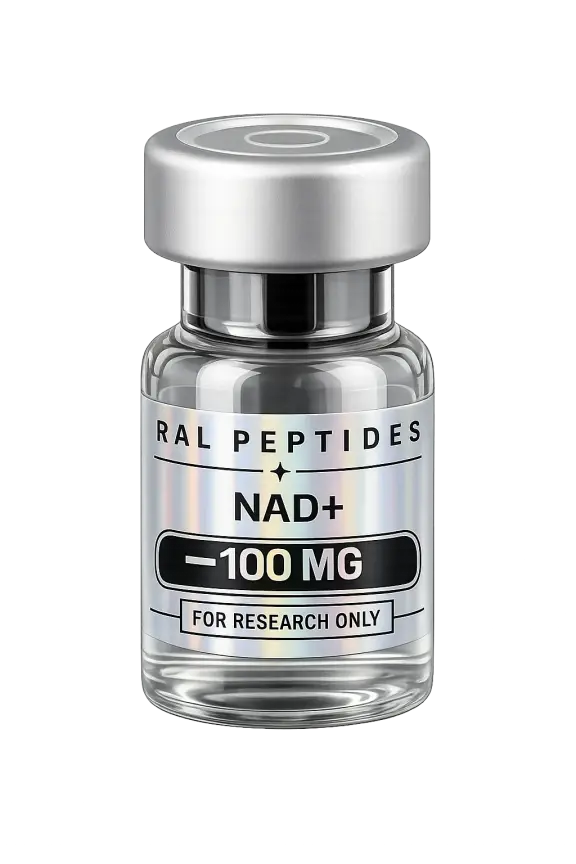
Chemical identity
- Molecular formula
- C21H27N7O14P2
- Molecular weight
- 663.43 g/mol
- CAS no.
- 53-84-9
Purity (HPLC) measures the absence of related impurities; it is distinct from net peptide content, since salts and counter-ions (acetate, TFA) count toward the vial mass. Account for this when computing the real concentration at reconstitution.
Potential benefits
Cellular energy
Supports ATP production and fights fatigue.
Mental clarity
Promotes cognitive function, concentration, and memory.
Optimal recovery
Accelerates energy recovery and reduces oxidative stress.
Cellular longevity
Activates sirtuins and supports cellular repair for healthy aging.
Performance & endurance
Improves resilience, endurance, and performance.
Overall resilience
Strengthens stress adaptation and overall cellular health.
Mechanism of action
- An essential coenzyme for ATP production in the mitochondria, the main source of cellular energy.
- Involved in the Krebs cycle and the mitochondrial respiratory chain to convert nutrients into usable energy.
- Activates PARP enzymes that detect and repair DNA breaks, preserving genetic integrity.
- Activates sirtuins, NAD+-dependent proteins that regulate the expression of genes linked to longevity, repair, and stress resistance.
- Improves mitochondrial biogenesis and energy efficiency, limiting age-related functional decline.
- Supports natural antioxidant defenses and limits oxidative damage (redox balance).
Historical milestones
Research milestones, clinical trials and regulatory steps.
- 1906
Discovery of cozymase
Arthur Harden and William Young observe that a heat-stable yeast factor accelerates fermentation, which they name a coferment (cozymase), later identified as NAD+.
- 1929
Nobel Prize in Chemistry
Harden and Hans von Euler-Chelpin receive the Nobel Prize in Chemistry for their work on sugar fermentation and cozymase.
- 1936
Redox role established
Otto Warburg demonstrates that NAD+ takes part in oxidation-reduction reactions via hydride transfer, identifying the active pyridine ring.
- 2000
NAD+ linked to aging
Imai and Guarente show that the Sir2 protein is an NAD+-dependent deacetylase, directly linking NAD+ metabolism to aging.
- 2010s-2020s
NAD+ and longevity
NAD+ precursors (nicotinamide riboside, NMN) are studied and marketed as supplements aiming to restore NAD+ that declines with age.
Evolution over time
Energy & mental clarity.
Recovery & performance.
Skin, anti-aging & longevity.
Dosages & protocol
Reference dosages
12 wk
Morning (energy, mental clarity), before training, or evening (optional, cellular repair during sleep). 2 to 5 times per week depending on goals and tolerance.
Circulating NAD+ has a short plasma half-life (on the order of minutes); it is rapidly taken up and recycled by cells, hence the value of repeated, regular administration.
Titration protocol
Stay on one step and let natural accumulation work. Progress slowly.
What is NAD+?
NAD+ is a coenzyme naturally present in every cell, essential to life. Its levels can drop by more than 50% between the ages of 30 and 60, contributing to fatigue, cognitive decline, and reduced performance.
- Energy production: essential for ATP production in the mitochondria.
- DNA repair: supports cellular repair mechanisms and genome integrity.
- Cellular protection: involved in defense against oxidative stress and damage.
- Brain function: supports cognitive health, memory, and mental clarity.
- Cellular longevity: activates sirtuins associated with healthy aging.
Areas and targets of action
Optimal NAD+ levels support several systems.
- Energy & mitochondria: supports ATP production and fights fatigue.
- Brain: focus, mental clarity, neurological recovery, and stress resilience.
- Longevity: limits oxidative stress, mitochondrial dysfunction, and cellular wear.
- Performance & recovery: useful for athletes, tired individuals, and active seniors.
- Metabolism: supports fat and glucose utilization and energy balance.
Research protocol rationale
Subcutaneously: 20 to 150 mg per injection. A very low starting dose (20 to 25 mg) is described to assess tolerance (NAD+ stings/burns), followed by a gradual increase up to ~150 mg maximum via the SC route. Higher doses (250 to 500 mg) are given via slow IV infusion in a medical setting — never subcutaneously.
- General wellness: 2 to 3 injections per week.
- Performance & recovery: 3 to 5 injections per week.
- Longevity & optimization: 3 to 5 injections per week.
- Very slow injection with site rotation to limit the burning sensation.
Optimizing results
The effects of NAD+ are cumulative and described as optimized through overall healthy living.
- Regular physical activity: naturally increases NAD+ levels.
- A diet rich in polyphenols and essential nutrients.
- Quality sleep: cellular regeneration and NAD+ balance.
- Stress management: chronic stress depletes NAD+ (meditation, breathing exercises).
- Adequate hydration to support cellular reactions and toxin elimination.
Usage tips
- Good hydration (2 to 3 L/day as described in the literature) is associated with better absorption, transport, and elimination of toxins.
- Protocols describe a very low starting dose (20 to 25 mg subcutaneously) followed by a gradual increase based on tolerance: NAD+ stings/burns upon injection.
- Subcutaneously, do not exceed ~150 mg per injection. Higher doses (250 to 500 mg and above) are only given via SLOW intravenous (IV) infusion (2 to 4 h) in a medical setting — never as a rapid subcutaneous injection.
- Protocols describe a very slow injection, with regular site rotation to limit the burning sensation.
- Consistency is key: effects are cumulative and improve over time.
- Combine with a healthy lifestyle: diet, training, sleep, and stress management.
Good to know / effects to watch
- Warmth or flushing (temporary redness) due to transient vasodilation.
- Mild, transient fatigue (a few hours to 24-48h), a sign the body is adapting.
- Mild headaches.
- Mild nausea (rare).
- Effects are generally temporary, disappearing within minutes to a few hours.
Storage
- Before reconstitution: lyophilized powder refrigerated (2-8 °C) or frozen (-20 °C), away from light and moisture.
- After reconstitution: keep refrigerated (2-8 °C), protected from light; use within a short window (a few weeks).
- Avoid heat, direct light and freeze-thaw cycles; inject very slowly subcutaneously and rotate sites (NAD+ stings on injection).
Contraindications
- Pregnancy and breastfeeding (insufficient safety data).
- History of or active cancer: caution, discuss with a physician.
- Severe hepatic or renal impairment, unstable cardiovascular disease: caution.
- Known hypersensitivity to NAD+ or a component.
- High doses (above 150 mg): only via slow IV infusion in a medical setting, never rapid SC injection.
Possible synergistic combinations
The catalog peptides are clickable — to complete or optimize your protocol.
NAD+ precursors.
Mitochondrial support.
View the sheet & add →Activation of the NAD+ pathway.
Sirtuins & longevity.
Antioxidant protection.
Energy & recovery.
Anti-inflammatory and cellular support.
Sources & references
Links to external sources (scientific databases, trial registries, authorities). RAL Peptides is not responsible for their content.
⚠ For research use only. NOT intended for use on humans or animals. The values shown are indicative and for informational purposes ; each person reacts differently. This guide does not replace medical advice — consult a healthcare professional if in doubt.