MOTS-c
Mitochondrial Open Reading Frame of the 12S rRNA type-c
MOTS-c is a mitochondrial peptide naturally present in the body that acts as a metabolic sensor. It promotes fat utilization, improves insulin sensitivity, and supports performance and longevity. By activating the AMPK pathway, it regulates energy metabolism, increases mitochondrial biogenesis, and contributes to better body composition and lasting health.
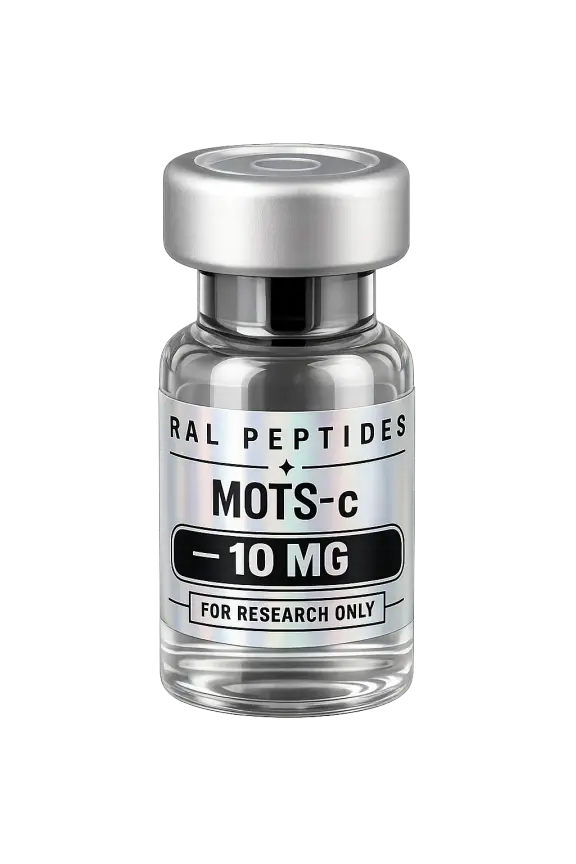
Chemical identity
- Sequence
- MRWQEMGYIFYPRKLR
- Molecular formula
- C101H152N28O22S2
- Molecular weight
- 2174.6 g/mol
- CAS no.
- 1627580-64-6
Purity (HPLC) measures the absence of related impurities; it is distinct from net peptide content, since salts and counter-ions (acetate, TFA) count toward the vial mass. Account for this when computing the real concentration at reconstitution.
Potential benefits
Energy metabolism
Stimulates metabolism and energy expenditure.
Body composition
Promotes reduction of fat mass.
Metabolic health
Improves insulin sensitivity.
Physical performance
Improves endurance and recovery.
Mitochondrial health
Supports mitochondrial function and biogenesis.
Cellular longevity
Contributes to cell protection and healthy aging.
Mechanism of action
- Localizes within mitochondria and acts as a metabolic sensor regulating cellular energy balance.
- Activates AMPK (AMP-activated protein kinase), a key enzyme and major regulator of cellular energy and longevity.
- Improves mitochondrial function by increasing mitochondrial biogenesis and efficiency as well as ATP production.
- Promotes fat oxidation as the primary energy source (increases lipolysis, even at rest).
- Improves insulin sensitivity and glycemic control.
- Systemic action across several key tissues (muscle, liver, adipose tissue, pancreas, nervous system); a well-tolerated endogenous peptide, with no androgenic or stimulant effect.
Historical milestones
Research milestones, clinical trials and regulatory steps.
- 2015
MOTS-c peptide discovered
Changhan Lee, in Pinchas Cohen's lab (USC), identifies MOTS-c, a 16-amino-acid peptide encoded by the mitochondrial 12S rRNA that regulates AMPK and insulin sensitivity.
- 2018
Translocation to the nucleus
Work shows MOTS-c moves to the cell nucleus to regulate metabolic stress-response genes, suggesting an exercise-mimetic-like role.
- 2019-2021
CB4211 clinical development
CohBar tests CB4211, an improved MOTS-c analog, in a phase 1a/1b clinical trial for NASH and obesity.
- 2021
Exercise-induced peptide
Reynolds and colleagues establish that MOTS-c is induced by exercise and improves physical performance and metabolic health in aged mice.
- 2021
Positive phase 1 results
CohBar reports positive results: good tolerability, lower liver markers (ALT/AST) and reduced liver fat.
Evolution over time
More stable daily energy and an increased sense of vitality and well-being.
Improved endurance and performance, better tolerance to exertion.
Easier post-exercise recovery.
Reduced fat mass, better glycemic control, and support for cellular longevity, with optimal results driven by consistency, patience, and discipline.
Dosages & protocol
Reference dosages
12 wk + 4 off
In the morning, often fasted; can be timed around physical activity depending on goals. Consistency matters more than a high dose.
Short plasma half-life (estimated 30-60 min in animal models); the metabolic signal (AMPK pathway) persists well beyond the peptide's presence in blood.
What is MOTS-c?
MOTS-c (Mitochondrial Open Reading Frame of the 12S rRNA type-c) is a mitochondrial peptide naturally present in the body, playing a key role in regulating energy metabolism, metabolic homeostasis, and body composition.
- Endogenous mitochondrial peptide encoded in mitochondrial DNA.
- Acts as a systemic metabolic signal between mitochondria and the cell nucleus.
- Regulates energy metabolism and promotes fat utilization.
- Improves insulin sensitivity.
- Supports overall metabolic health.
Metabolic targets and effects
- Activates AMPK, a major regulator of cellular energy and longevity.
- Systemic action across several key tissues: muscle, liver, adipose tissue, pancreas, and nervous system.
- Promotes fat oxidation as the primary energy source.
- Improves insulin sensitivity and glycemic control.
- Increases mitochondrial biogenesis and efficiency (ATP production).
- A well-tolerated endogenous peptide, with no androgenic or stimulant effect.
Research protocol rationale
- Start low (2.5 mg) to assess individual response before any increase.
- Common use 5 mg; advanced users up to 10 mg (split across 2 injections).
- Described frequency: 2 to 3 injections per week rather than high daily doses.
- Common cycles of 4 to 12 weeks, followed by 2 to 4 week breaks.
- Fasted morning or pre-workout: windows described in the literature; consistency matters more than timing.
Signs of effective use
- More stable daily energy.
- Improved endurance and performance.
- Easier post-exercise recovery.
- Better tolerance to exertion.
- Increased sense of vitality and well-being.
Usage tips
- Protocols describe starting at 2.5 mg to assess individual response before any dose increase.
- Daily consistency matters more than timing for lasting results.
- Balanced diet: favor whole, nutrient-dense foods with sufficient protein and healthy fats.
- Regular training: combine strength training and cardio to stimulate mitochondria.
- Quality sleep: restorative sleep optimizes recovery and insulin sensitivity.
- Stress management: chronic stress can negatively affect metabolism and energy.
- Cycle length is adjusted based on individual tolerance and goals.
Good to know / effects to watch
- Studies report transient hot flashes or a flushing sensation.
- Transient fatigue and mild digestive discomfort may occur.
- Local injection site reactions (redness, discomfort).
- Given its metabolic action, hypoglycemia is possible: monitor blood glucose with caution.
- Generally well tolerated at studied doses; human data nonetheless remain limited.
Storage
- Before reconstitution: lyophilized powder stable for months at room temperature; longer storage refrigerated (2-8 °C) or frozen (-20 °C), away from light.
- After reconstitution: keep refrigerated (2-8 °C), protected from light; use within ~28 days.
- Avoid freeze-thaw cycles; inject with sterile equipment and rotate sites.
Contraindications
- Diabetes or hypoglycemia: monitor blood glucose (effect on insulin sensitivity, risk of hypoglycemia).
- Pregnancy and breastfeeding (insufficient human data).
- Known hypersensitivity to the peptide.
- Non-approved compound (research use), limited human clinical data: not a substitute for medical advice.
Possible synergistic combinations
The catalog peptides are clickable — to complete or optimize your protocol.
Energy support.
View the sheet & add →Cellular energy production.
Metabolic and anti-inflammatory support.
Muscle function and recovery.
Stimulates mitochondrial adaptation.
Sources & references
Links to external sources (scientific databases, trial registries, authorities). RAL Peptides is not responsible for their content.
⚠ For research use only. NOT intended for use on humans or animals. The values shown are indicative and for informational purposes ; each person reacts differently. This guide does not replace medical advice — consult a healthcare professional if in doubt.