KPV
Lys-Pro-Val
KPV (Lys-Pro-Val) is a naturally occurring bioactive peptide corresponding to the C-terminal sequence of α-MSH (melanocyte-stimulating hormone). Made up of three amino acids — Lysine, Proline, and Valine — it has powerful anti-inflammatory, healing, and regenerative properties, targeting root processes rather than symptoms. It acts deeply to reduce inflammation, speed up tissue repair, and restore balance across many tissues and systems in the body.
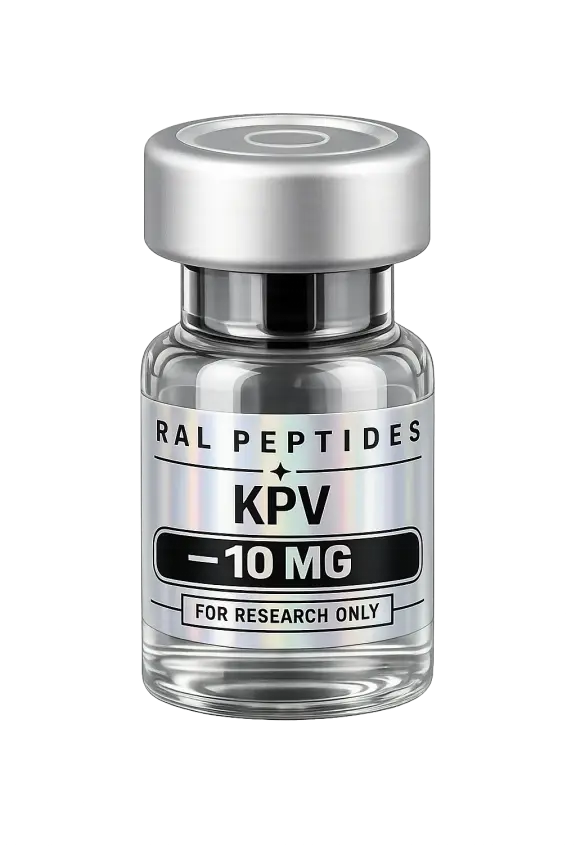
Chemical identity
- Sequence
- KPV (Lys-Pro-Val)
- Molecular formula
- C16H30N4O4
- Molecular weight
- 342.43 g/mol
- CAS no.
- 67727-97-3
Purity (HPLC) measures the absence of related impurities; it is distinct from net peptide content, since salts and counter-ions (acetate, TFA) count toward the vial mass. Account for this when computing the real concentration at reconstitution.
Potential benefits
Reduces inflammation
Rapidly calms acute and chronic inflammation.
Speeds up healing
Promotes faster, higher-quality wound healing.
Optimal gut health
Improves symptoms of inflammatory bowel disease (IBD) such as Crohn’s or ulcerative colitis.
Joint health
Relieves joint pain and supports repair of cartilage and connective tissue.
Skin health
Helps treat acne, eczema, and psoriasis and improves skin regeneration.
Recovery & performance
Reduces muscle soreness and speeds up recovery after intense training.
Mechanism of action
- Cytokine modulation: inhibits production of key pro-inflammatory cytokines (TNF-α, IL-6, IL-1β, IFN-γ) and reduces both acute and chronic inflammation.
- Cellular protection: protects cells against oxidative stress and inflammatory damage.
- Tissue repair: activates fibroblasts and collagen synthesis, promoting tissue regeneration.
- Barrier reinforcement: improves the integrity of skin and gut barriers, strengthens tight junctions, and reduces intestinal permeability.
- Immune balance: regulates the immune response to limit chronic inflammation while supporting healing.
Historical milestones
Research milestones, clinical trials and regulatory steps.
- 1980s
α-MSH found anti-inflammatory
Anna Catania, James Lipton and colleagues show the hormone α-MSH reduces fever and inflammation, beyond its known role in pigmentation.
- 1989
KPV activity discovered
Hiltz and Lipton demonstrate that the C-terminal tripeptide Lys-Pro-Val (KPV) retains α-MSH's anti-inflammatory activity without its pigmentary effect.
- 1990s-2000s
Anti-inflammatory mechanism
Studies identify KPV as an inhibitor of the NF-κB pathway, effective in animal models of intestinal, skin and bronchial inflammation.
- 2008
Intestinal uptake via PepT1
Dalmasso, Merlin and colleagues show KPV is taken up by the PepT1 transporter and reduces intestinal inflammation at low doses.
- 2010s-2020s
Ongoing preclinical research
KPV continues to be studied preclinically (inflammatory bowel disease, skin) with no approved drug to date.
Evolution over time
First effects may be felt (reduced inflammation).
Benefits increase: faster healing, more resilient tissue, and better tissue function.
Lasting reduction in inflammatory markers, improved gut barrier, and regeneration of damaged tissue.
Dosages & protocol
Reference dosages
12 wk + 4 off
Morning while fasted, ideal for an anti-inflammatory effect throughout the day
Estimated plasma half-life around 2-4 h (longer than native α-MSH, ~10 min); the anti-inflammatory cascade persists 12-24 h after clearance.
What is KPV?
KPV is a naturally occurring tripeptide (Lysine – Proline – Valine) corresponding to the C-terminal sequence of α-MSH. It targets inflammatory and regenerative processes at the source.
- Composition: Lysine (tissue repair), Proline (collagen), Valine (recovery).
- Formula C16H30N4O4, ~342.4 Da; stable for systemic or local use.
- Multi-system action: skin, gut, joints, muscles, immunity.
- No hormonal effect: does not influence androgen or thyroid receptors.
- Acts at the root rather than on symptoms.
Areas and targets of action
- Gut health: inflammatory bowel disease (Crohn’s, UC), irritable bowel, permeability, dysbiosis.
- Skin health: acne, eczema / dermatitis, psoriasis, wound healing, skin regeneration.
- Joint health: arthritis, tendinitis, joint pain, cartilage repair.
- Immune support: modulation of inflammation, autoimmunity, recovery phase.
- Recovery: reduced soreness, tissue repair, sustained performance.
- Overall health: systemic anti-inflammatory action, cell protection, general well-being.
Research protocol rationale
- Start at the lowest effective dose, adjusted according to individual response.
- Anti-inflammatory goal: 250 to 500 mcg per day, 8 to 12 week course.
- Tissue repair: 500 mcg per day, 8 to 16 week course.
- Gut or skin support: 250 to 500 mcg per day, 4 to 12 week course.
- Cycle described: 8 to 12 weeks of use followed by 2 to 4 weeks off.
Optimizing results
The effects of KPV are described as optimized by a comprehensive approach.
- Consistency matters more than exact timing: fit the injection into the routine.
- Anti-inflammatory diet rich in antioxidants, omega-3s, and polyphenols.
- Optimal hydration, restorative sleep (7 to 9 h), stress management.
- Can be used continuously or in cycles depending on needs and goals.
- Local reactions possible at the injection site: rotate sites.
Usage tips
- Always start at the lowest dose and adjust according to individual response.
- Consistency matters more than exact timing: the timing that best fits the routine, done regularly, is preferred.
- Can be injected in the morning while fasted, before training to support recovery, or in the evening (optional) to support overnight repair.
- KPV can be used continuously or in cycles depending on needs and goals. Listen to your body and adjust as needed.
- Favor an anti-inflammatory diet rich in antioxidants, omega-3s, and polyphenols.
- Optimal hydration, restorative sleep (7 to 9 hours), stress management, and appropriate training optimize results.
Good to know / effects to watch
- Generally well tolerated: few systemic effects reported in available studies.
- Local reactions (redness, discomfort) may occur at the site of topical application or subcutaneous injection.
- Rare hypersensitivity reactions have been described.
- Human data remain limited; known hypersensitivity to the compound: avoid use.
Storage
- Before reconstitution: lyophilized powder stable for months; store refrigerated (2-8 °C) or frozen (-20 °C), away from light.
- After reconstitution: keep refrigerated (2-8 °C), protected from light; use within ~28 days.
- Avoid freeze-thaw cycles; handle with sterile equipment and rotate injection sites.
Contraindications
- Known hypersensitivity to KPV or an excipient.
- Pregnancy and breastfeeding (insufficient human data).
- Caution with autoimmune disease or immunomodulatory therapy (effect on the immune response).
- Non-approved compound (research use): not a substitute for the management of IBD or inflammatory disease, or for medical advice.
Possible synergistic combinations
The catalog peptides are clickable — to complete or optimize your protocol.
Speeds up repair of tissues, tendons, and the gut.
View the sheet & add →Promotes cell regeneration and injury repair.
View the sheet & add →Supports collagen synthesis and wound healing.
Support immune response and cell repair.
Reinforces the anti-inflammatory effect and cellular health.
Sources & references
Links to external sources (scientific databases, trial registries, authorities). RAL Peptides is not responsible for their content.
Featured in these stacks
⚠ For research use only. NOT intended for use on humans or animals. The values shown are indicative and for informational purposes ; each person reacts differently. This guide does not replace medical advice — consult a healthcare professional if in doubt.