Épitalon
Epithalon / Epithalone — tétrapeptide pinéal (Ala-Glu-Asp-Gly)
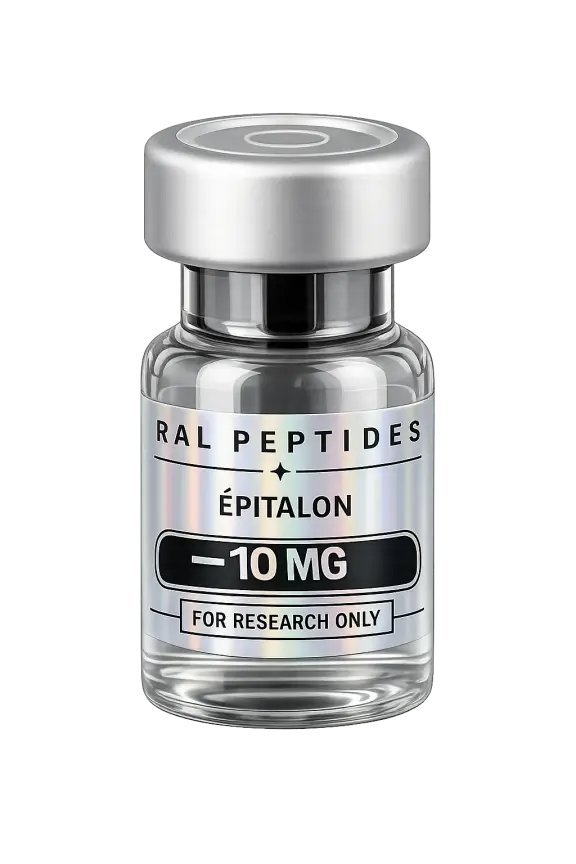
Epitalon (Epithalon / Epithalone) is a synthetic tetrapeptide (Ala-Glu-Asp-Gly) derived from epithalamin, a peptide extract from the pineal gland. It is studied for research purposes for its influence on telomerase activity, an enzyme involved in maintaining telomere length, as well as for its role in regulating melatonin secretion and the circadian rhythm. Administered subcutaneously, it is generally used in short, repeated cycles (10 to 20 days, 1 to 2 times per year) rather than continuously.
Chemical identity
- Sequence
- Ala-Glu-Asp-Gly (AEDG)
- Molecular formula
- C14H22N4O9
- Molecular weight
- 390.35 g/mol
- CAS no.
- 307297-39-8
Purity (HPLC) measures the absence of related impurities; it is distinct from net peptide content, since salts and counter-ions (acetate, TFA) count toward the vial mass. Account for this when computing the real concentration at reconstitution.
Potential benefits
Telomerase activation
Promotes telomerase activity, an enzyme involved in maintaining telomere length.
Melatonin regulation
Supports pineal gland function and the body's natural melatonin production.
Circadian rhythm
Participates in regulating the sleep-wake cycle and synchronizing the biological clock.
Sleep quality
May promote deeper, more restorative sleep, especially when sleep is disrupted.
Cellular longevity
Part of research into healthy cellular aging and chromosome protection.
Immune modulation
Studied for possible support of the immune response via its action on interleukin-2.
Mechanism of action
- A tetrapeptide (Ala-Glu-Asp-Gly) derived from epithalamin, a peptide extract from the bovine pineal gland.
- Stimulates telomerase activity, the enzyme that regulates the lengthening of telomeres at the ends of chromosomes.
- Partially restores pineal function and physiological melatonin secretion, which is often reduced with age.
- Modulates the expression of certain genes linked to the cell cycle and senescence.
- Influences the activity of interleukin-2 and certain enzymes (including acetylcholinesterase), suggesting a broader systemic action beyond the pineal sphere alone.
Historical milestones
Research milestones, clinical trials and regulatory steps.
- 1980s
Origin in Epithalamin
Vladimir Khavinson develops Epithalamin in Russia, a polypeptide extract of bovine pineal gland that is the conceptual basis for Epitalon.
- 1990s
Synthesis of the tetrapeptide
Epitalon (Ala-Glu-Asp-Gly, AEDG) is synthesized as a short analog reproducing the activity of the pineal extract.
- 2003
Telomerase activation
Khavinson and colleagues report induction of telomerase and telomere elongation in cultured human somatic cells.
- 2026
Unapproved peptide
Epitalon remains a research peptide, with data coming largely from Khavinson's group and no regulatory approval.
Evolution over time
Progressive improvement in sleep quality and the feeling of nighttime recovery.
Sleep-wake rhythm often perceived as more regular, with more stable daytime energy.
Effects reported as extending beyond the administration period, despite the peptide's short half-life.
Intended goal: cumulative support of healthy cellular aging over the long term.
Dosages & protocol
Reference dosages
2 wk + 16 off
Ideally in the evening, 1 to 2h before bedtime, to align with the natural melatonin peak; daily injection throughout the cycle
Very short plasma half-life (on the order of minutes); reported effects outlast the peptide's presence in blood, which supports the short repeated-course protocol.
What is Epitalon?
Epitalon is a synthetic tetrapeptide reproducing the active sequence of epithalamin, a peptide extract from the pineal gland. It is studied mainly for its influence on cellular aging and pineal function.
- A tetrapeptide of 4 amino acids: Ala-Glu-Asp-Gly (AEDG).
- Synthetic derivative of epithalamin (extract from the bovine pineal gland).
- Studied for its action on telomerase and melatonin regulation.
- Used in research as short, repeated cycles rather than continuous use.
Recommended dilution (10 mg vial, U-100 syringe)
- 2 ml of BAC → 5 mg/ml → 100 units = 5 mg (standard protocol).
- 1 ml of BAC → 10 mg/ml → injection volume halved for the same dose.
- For a 5 mg dose: approximately 100 units at 5 mg/ml, or 50 units at 10 mg/ml.
- Store the reconstituted solution in the refrigerator and use within the recommended timeframe.
Cycles and pace of use
Unlike many peptides used continuously, Epitalon is generally administered in short, intensive cycles.
- Typical cycle: 10 to 20 consecutive days, injected daily.
- 1 to 2 cycles per year, spaced several months apart.
- Consistency of injections during the cycle matters more than high doses.
Usage tips
- Favor an evening injection, 1 to 2 hours before bedtime, to align with the natural melatonin peak.
- Follow short cycles (10 to 20 days), repeated 1 to 2 times per year, rather than continuous use.
- Reconstitute with care and store the solution in the refrigerator between injections.
- Start with the lowest dose in the research range to assess individual tolerance.
- Maintain good sleep hygiene (darkness, regular schedule) to optimize the effect on circadian rhythm.
Good to know / effects to watch
- Generally well tolerated over short cycles.
- Redness, slight pain, or transient discomfort at the injection site.
- Possible drowsiness or fatigue, particularly with late-evening injections.
- Transient headaches or dizziness reported by some users.
- Pregnancy and breastfeeding: to be avoided as a precaution.
- History of tumor pathology or ongoing hormonal treatment: seek medical advice before any use.
Storage
- Before reconstitution: store the lyophilized powder refrigerated (2-8 °C) or frozen (-20 °C), protected from light and moisture.
- After reconstitution: keep refrigerated (2-8 °C) and use during the course (within ~28 days).
- Do not freeze the reconstituted solution; protect it from light.
Contraindications
- Pregnancy and breastfeeding: avoid as a precaution.
- History of tumoral disease or active cancer: caution and medical advice required (action on telomerase and the cell cycle).
- Ongoing hormonal treatment: seek medical advice before use.
- Known hypersensitivity to the compound; not advised in children.
- Unapproved research compound (FDA/EMA), with data largely from a single research group.
Possible synergistic combinations
The catalog peptides are clickable — to complete or optimize your protocol.
Possible synergy in regulating circadian rhythm and sleep quality.
Frequently combined as part of an overall cellular longevity approach.
View the sheet & add →Combination sometimes used in anti-aging research, on complementary axes (skin / cellular).
View the sheet & add →Sources & references
Links to external sources (scientific databases, trial registries, authorities). RAL Peptides is not responsible for their content.
⚠ For research use only. NOT intended for use on humans or animals. The values shown are indicative and for informational purposes ; each person reacts differently. This guide does not replace medical advice — consult a healthcare professional if in doubt.