Sémaglutide
Agoniste du récepteur GLP-1
Semaglutide is a GLP-1 receptor agonist, a gut hormone involved in regulating appetite and blood glucose. Its long half-life (~7 days) allows for a single weekly injection; titration is deliberately slow to protect digestive tolerance.
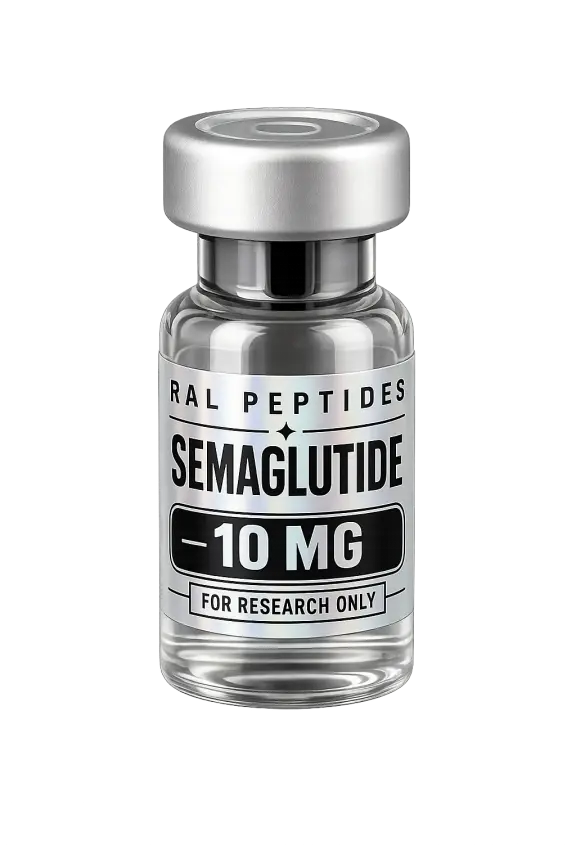
Chemical identity
- Sequence
- 31-mer modifié (Aib8, Lys26 acylée C18 diacide via γGlu-2×OEG)
- Molecular formula
- C187H291N45O59
- Molecular weight
- 4113.58 g/mol
- CAS no.
- 910463-68-2
Purity (HPLC) measures the absence of related impurities; it is distinct from net peptide content, since salts and counter-ions (acetate, TFA) count toward the vial mass. Account for this when computing the real concentration at reconstitution.
Potential benefits
Reduced appetite
Decreases the sensation of hunger by acting on the satiety centers of the hypothalamus.
Stabilized blood glucose
Stimulates glucose-dependent insulin secretion and suppresses glucagon.
Prolonged satiety
Slows gastric emptying, extending the feeling of fullness after meals.
Weekly injection
A half-life of about 7 days allows for a once-weekly injection schedule.
Mechanism of action
- Binds to the GLP-1 receptor and mimics the action of the endogenous incretin hormone.
- Central: activates POMC/CART neurons (satiety) and inhibits NPY/AgRP neurons (hunger), reducing spontaneous caloric intake.
- Pancreas: glucose-dependent insulin secretion and glucagon suppression, promoting more stable blood glucose.
- Digestive: slows gastric emptying, prolonging satiety but also explaining the initial digestive side effects.
- Long half-life (~7 days) → gradual accumulation; steady state reached after approximately 4 to 5 weeks at a constant dose.
Historical milestones
Research milestones, clinical trials and regulatory steps.
- 2012
First clinical trials
A phase 2 dose-finding trial of semaglutide in type 2 diabetes is published in The Lancet.
- Dec 2017
FDA approval (Ozempic)
The FDA approves once-weekly injectable semaglutide as Ozempic for type 2 diabetes on 5 December 2017.
- 2019
Oral version (Rybelsus)
The FDA approves once-daily oral semaglutide as Rybelsus for type 2 diabetes.
- Jun 2021
FDA approval (Wegovy)
The FDA approves semaglutide 2.4 mg as Wegovy for chronic weight management on 4 June 2021.
- 2023
SELECT cardiovascular results
The SELECT trial shows reduced cardiovascular events, leading to a label expansion in 2024.
- Dec 2025
Oral Wegovy approved
The FDA approves oral Wegovy (semaglutide 25 mg), the first oral GLP-1 for weight management.
Evolution over time
Adjustment at 0.25 mg: first effects on appetite, possible transient digestive effects.
Increase to 0.5 mg: more pronounced satiety, more stable energy, beginning of fat mass reduction.
Higher doses depending on tolerance: more steady weight loss and better hunger management.
Dosages & protocol
Reference dosages
16 wk
The same day each week (with or without food)
~7 days (about one week) — allows a single weekly injection
Titration protocol
Stay on one step and let natural accumulation work. Progress slowly.
Titration logic
Semaglutide has a long half-life (~7 days): its effect accumulates over time. Titration proceeds in roughly 4-week steps (0.25 → 0.5 → 1.0 mg, etc.) to allow the body to adapt and limit nausea. The dose is only increased if the previous step is well tolerated.
Signs to monitor
- Positive: natural satiety, stable energy, good digestion, gradual weight loss.
- Needs adjusting: persistent nausea, significant fatigue, dizziness, total loss of appetite, dehydration.
Golden rule
Consistency matters more than intensity. Adjustments should be made slowly, based on objective data (weight, waist circumference, hunger, energy) rather than by rushing the dose increase.
Suggested adjustment scale (for guidance)
- Insufficient loss / plateau after stabilization → move up to the next step every 4 weeks if well tolerated.
- Loss too fast (> 1%/week) → maintain the current step or slightly increase calorie intake.
- Bothersome side effects → stay at the current step, drop back to the previous step, or take a pause.
Usage tips
- Follow the titration schedule: one month per step before considering the next dose.
- Inject on the same day each week to maintain a regular rhythm.
- Favor light, smaller, more frequent meals; avoid fatty foods that worsen nausea.
- Maintain good hydration and sufficient electrolyte intake (sodium, potassium, magnesium).
- Prioritize adequate protein intake (1.6 to 2.2 g/kg) to preserve lean mass.
- Keep a log: weight, waist circumference, hunger, digestive symptoms, energy.
Good to know / effects to watch
- Nausea (the most common effect, especially at the start of the protocol or after a dose increase).
- Bloating, constipation or diarrhea, early satiety, belching.
- Headaches, transient fatigue, sometimes dizziness related to reduced food intake.
- Most digestive effects subside within days to weeks with slow titration.
- Watch for (consult a doctor if severe/persistent): repeated vomiting, intense and prolonged abdominal pain, signs of dehydration, severe hypoglycemia.
Storage
- Before reconstitution (lyophilized powder): refrigerated (2-8 °C), away from light; tolerates short periods at room temperature during shipping.
- After reconstitution: refrigerated (2-8 °C), typically use within ~4 weeks (28 days).
- Do not freeze, do not shake vigorously, avoid heat and direct light.
Contraindications
- Pregnancy and breastfeeding: avoid.
- Personal or family history of medullary thyroid carcinoma (MTC) or multiple endocrine neoplasia type 2 (MEN 2): contraindication.
- History of pancreatitis; diabetic retinopathy (monitoring); gallbladder disease; gastroparesis: caution.
- Interactions: hypoglycemia risk with insulin or sulfonylureas; delayed gastric emptying may alter absorption of oral drugs.
- Known hypersensitivity to semaglutide or any excipient.
Possible synergistic combinations
Sodium, potassium, magnesium — limit fatigue, cramps and headaches during the calorie deficit.
Helps preserve lean mass during caloric intake reduction.
Sources & references
Links to external sources (scientific databases, trial registries, authorities). RAL Peptides is not responsible for their content.
⚠ For research use only. NOT intended for use on humans or animals. The values shown are indicative and for informational purposes ; each person reacts differently. This guide does not replace medical advice — consult a healthcare professional if in doubt.