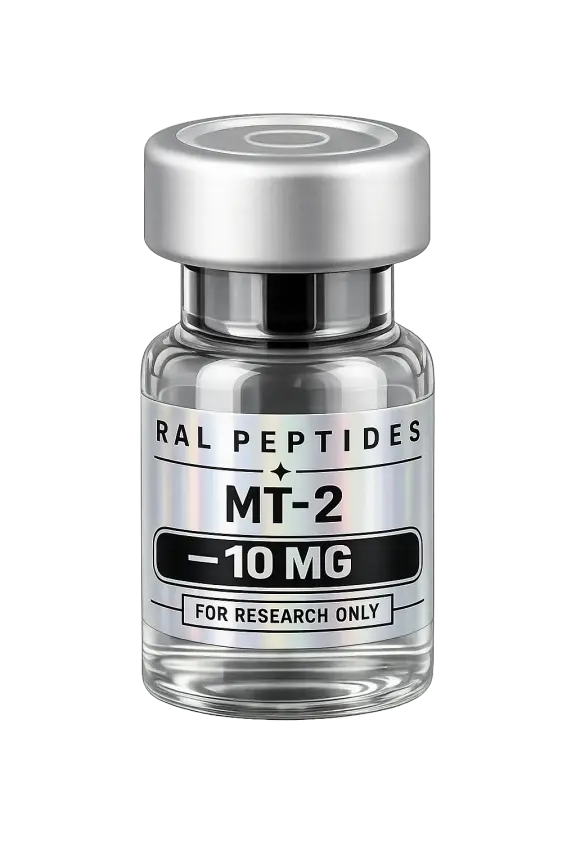
MT-2
Melanotan 2
MT2 (Melanotan 2) is a peptide analog of α-MSH (melanocyte-stimulating hormone). It acts mainly on the MC1R (Melanocortin 1 Receptor) receptors present in skin melanocytes and stimulates the production of eumelanin (dark melanin). It is studied strictly for research purposes for its action on melanogenesis and skin pigmentation, as well as for its described effects on UV resistance and skin quality. RESEARCH USE ONLY – NOT FOR HUMAN CONSUMPTION.
Chemical identity
- Sequence
- Ac-Nle-cyclo[Asp-His-D-Phe-Arg-Trp-Lys]-NH2 (heptapeptide cyclique)
- Molecular formula
- C50H69N15O9
- Molecular weight
- 1024.2 g/mol
- CAS no.
- 121062-08-6
Purity (HPLC) measures the absence of related impurities; it is distinct from net peptide content, since salts and counter-ions (acetate, TFA) count toward the vial mass. Account for this when computing the real concentration at reconstitution.
Potential benefits
Melanogenesis stimulation
Studied for its strong stimulation of melanogenesis, associated in research with faster, deeper, more even pigmentation.
UV resistance
Studied for the increase in the skin's resistance to UV rays, associated with a reduced risk of cellular damage.
Anti-aging & regenerating effect
Antioxidant action described as preserving elasticity, hydration, and overall skin quality.
Explored metabolic effects
Studied for possible effects on recovery, energy, and metabolism via its hormonal actions.
Potential neuroprotective effects
Studies suggest benefits for neuronal protection and cognitive health.
Mechanism of action
- MT2 is a NON-selective agonist of melanocortin receptors: it activates both MC1R (melanocytes) and MC3R / MC4R (central nervous system).
- Via MC1R: stimulation of the tyrosinase enzyme, increased melanin production followed by transfer to keratinocytes → faster, darker, longer-lasting tanning.
- MC1R directs production toward eumelanin (dark melanin) rather than pheomelanin (red/yellow melanin).
- Via the MC4R pathway: this central activation is studied for its effects on erectile function and libido.
- Also via MC4R: a reduction in appetite and modulation of food intake are described.
- This non-selective spectrum of action explains additional systemic effects (nausea, hot flushes, ↑ libido) absent from a purely pigmentary agonist.
Historical milestones
Research milestones, clinical trials and regulatory steps.
- 1980s
Synthesis at University of Arizona
Melanotan II is designed by Victor Hruby and Mac Hadley as a lactam-bridged cyclic heptapeptide, an α-MSH analog aimed at a photoprotective tan.
- 1991
University patents
The University of Arizona files the foundational patents covering Melanotan II and related melanocortin analogs.
- 1996
Phase I clinical study
The pilot study by Dorr et al. observes not only pigmentation but also spontaneous erections, revealing the compound's sexual activity.
- 1990s
Birth of bremelanotide
The sexual-arousal effect is isolated and developed separately as PT-141 / bremelanotide.
- 2020s
No approval
Melanotan II has never been approved as a drug; it circulates illegally as an unlicensed tanning agent, with warnings issued by health authorities.
Evolution over time
Start of exposure to the compound, no visible pigmentation.
First signs of pigmentation described.
Priming phase: melanogenesis is initiated.
Well-established pigmentation in the models.
Pigmentation intensification phase.
Maximum pigmentation described.
Maintenance phase: the pigmentation achieved is prolonged.
Dosages & protocol
Reference dosages
3 wk + 1 off
1 injection/day during the priming and exposure phase; 2 to 3 injections/week during the maintenance phase.
Short plasma half-life (on the order of 1 h); a cyclic heptapeptide somewhat more stable than native α-MSH, with a pigmentation effect that persists for several days after clearance.
Titration protocol
Stay on one step and let natural accumulation work. Progress slowly.
What is MT-2?
MT-2 (Melanotan 2) is a peptide analog of α-MSH studied for its action on melanogenesis and skin pigmentation. RESEARCH USE ONLY – NOT FOR HUMAN CONSUMPTION.
- Acts on the MC1R receptors of melanocytes to produce eumelanin (dark melanin).
- Non-selective agonist: also activates the MC3R / MC4R pathways (systemic effects).
- Studied for faster, deeper, longer-lasting tanning.
- Contexts studied: rapid tanning, better sun tolerance, skin quality.
- Does not replace sun protection: responsible exposure remains essential.
Areas and targets of action
- Melanogenesis: faster, deeper, more even pigmentation.
- UV resistance: increased skin resistance to UV rays.
- Anti-aging: antioxidant action preserving elasticity and hydration.
- Results vary by phototype: from golden tan (fair) to ebony black (very dark).
- Systemic effects described via MC4R: increased libido, transient decrease in appetite.
- Potential neuroprotective effects explored.
Research protocol rationale
The doses described vary according to phototype and research objectives.
- Priming: 250 to 500 mcg/day over 5 to 7 days — initiation of melanogenesis.
- Intense pigmentation: 500 to 1000 mcg/day over 10 to 14 days.
- Maintenance: 250 to 500 mcg, 2 to 3 times a week.
- Start at the lowest dose to assess tolerance, then progress.
- Alternate injection sites to avoid irritation and lipodystrophy.
Optimizing results
Consistency and moderation are described as key to stable, long-lasting pigmentation.
- Progressiveness: gradually increase light exposure for skin adaptation.
- Hydration and a diet rich in antioxidants (vit. C, E, beta-carotene, zinc).
- Broad-spectrum sun protection after the priming phase.
- Regular exfoliation (1 to 2 times a week) for even pigmentation.
- Sufficient sleep and rest days for skin regeneration.
Usage tips
- Adequate hydration supports skin health.
- Sun protection is described when pigmentation is not the desired goal.
- Regular exfoliation (1 to 2 times a week) is associated with more even pigmentation.
- A diet rich in antioxidants (vit. C, E, beta-carotene) is described as a cofactor.
- Sufficient sleep supports cellular regeneration.
- A healthy lifestyle is described as maximizing the effects of MT2.
Good to know / effects to watch
- Nausea, particularly at the start of the protocol (effect linked to MC4R activation, more pronounced than with MT1).
- Hot flushes and flushing frequently described.
- Change in libido (increase) reported via the MC4R pathway.
- Transient decrease in appetite.
- Spots / moles and darkening of nevi (increased melanocyte activity): to be monitored.
- Injection site reactions (redness, discomfort).
Storage
- Before reconstitution: lyophilized powder away from light and moisture, preferably refrigerated (2-8 °C).
- After reconstitution: refrigerate (2-8 °C), protect from light; use within ~4 weeks.
- Never freeze; swirl the vial gently, do not shake.
Contraindications
- Personal or family history of melanoma or other skin cancer.
- Atypical, numerous or changing naevi: dermatological monitoring is essential.
- Pregnancy and breastfeeding.
- Priapism risk / severe erectile disorders (central MC4R activation) and uncontrolled cardiovascular disease: caution.
- Known hypersensitivity to the peptide or an excipient.
Possible synergistic combinations
Tanning & Skin: optimal tanning, recovery, and tissue regeneration.
Anti-aging & Protection: cellular protection, longevity, and vitality.
Performance & Recovery: muscle recovery, reduced oxidative stress.
Overall health: immunity, cardiovascular health, and general well-being.
Optimal tanning: intense tan, regeneration, and protection.
Sources & references
Links to external sources (scientific databases, trial registries, authorities). RAL Peptides is not responsible for their content.
⚠ For research use only. NOT intended for use on humans or animals. The values shown are indicative and for informational purposes ; each person reacts differently. This guide does not replace medical advice — consult a healthcare professional if in doubt.