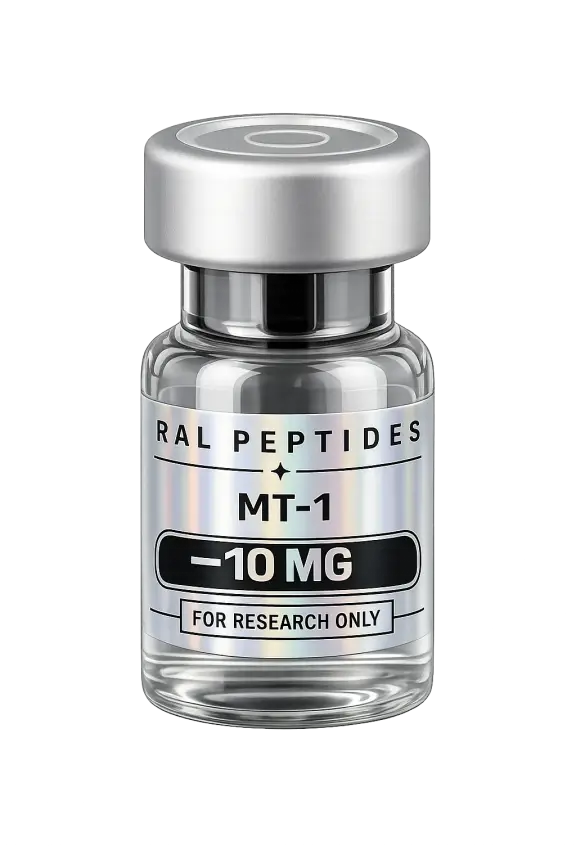
MT-1
Melanotan 1 / MT1
MT1 (Melanotan 1) is a peptide analog of α-MSH (melanocyte-stimulating hormone). It acts mainly on the MC1R receptors found in skin melanocytes. By stimulating melanin production, it is studied strictly for research purposes for its action on skin pigmentation and resistance to UV rays. RESEARCH USE ONLY – NOT FOR HUMAN CONSUMPTION.
Chemical identity
- Sequence
- Ac-Ser-Tyr-Ser-Nle-Glu-His-D-Phe-Arg-Trp-Gly-Lys-Pro-Val-NH2 ([Nle4,D-Phe7]-α-MSH)
- Molecular formula
- C78H111N21O19
- Molecular weight
- 1646.8 g/mol
- CAS no.
- 75921-69-6
Purity (HPLC) measures the absence of related impurities; it is distinct from net peptide content, since salts and counter-ions (acetate, TFA) count toward the vial mass. Account for this when computing the real concentration at reconstitution.
Potential benefits
Melanogenesis stimulation
Studied for accelerating melanin production, associated in research with faster, deeper, and more even pigmentation.
UV resistance
Studied for increasing the skin's natural resistance to UV rays, associated with a reduced risk of cellular damage.
Anti-aging and regenerative effect
Antioxidant action described as improving skin elasticity, hydration, and overall quality.
Explored metabolic effects
Studied for possible effects on recovery, energy, and metabolism via its hormonal actions.
Potential neuroprotective effects
Some studies suggest benefits for neuronal protection and cognitive health.
Mechanism of action
- MT1 (afamelanotide) is a SELECTIVE agonist of the melanocyte MC1R receptor: its action is essentially pigmentary.
- Activation of the intracellular signaling pathway specific to MC1R (cAMP).
- Stimulation of the tyrosinase enzyme and increased melanin production.
- Transfer of melanin to keratinocytes → faster, darker, and longer-lasting tan.
- MC1R directs production toward eumelanin (dark melanin) rather than pheomelanin (red/yellow melanin).
- Selectivity for MC1R limits systemic effects: unlike MT2, there is no notable action on the MC3R / MC4R pathways, and therefore no marked effect on libido or appetite.
Historical milestones
Research milestones, clinical trials and regulatory steps.
- 1980s
Synthesis at University of Arizona
The [Nle4, D-Phe7]-α-MSH analog is synthesized by the teams of Mac Hadley and Victor Hruby as a photoprotective, melanin-stimulating agent.
- 2000s
Developed by Clinuvel
Clinuvel (formerly EpiTan) develops afamelanotide as a sustained-release subcutaneous implant for photodermatological diseases.
- 2008
EMA orphan designation
Afamelanotide receives EMA orphan drug designation for erythropoietic protoporphyria (EU/3/08/541).
- 2014
European authorization (Scenesse)
The European Commission grants marketing authorization for Scenesse in erythropoietic protoporphyria on 22 December 2014.
- 2019
FDA approval
The FDA approves afamelanotide (Scenesse) on 8 October 2019 to increase pain-free light exposure in adults with erythropoietic protoporphyria.
Evolution over time
Saturation of MC1R receptors (priming phase). The first color changes may appear as early as 3 to 7 days depending on sun exposure and skin phototype.
Onset of a visible, darker tan.
Well-established, stable, and even tan.
Optimal tan and long-term maintenance.
Dosages & protocol
Reference dosages
12 wk + 6 off
Priming phase: 1 injection per day for 2 to 3 weeks. Maintenance phase: 2 to 3 injections per week (1 to 2 times per week for maintenance).
Short plasma half-life (about 30 min to 1 h after SC injection, mainly renal clearance); the pigmentation effect nonetheless persists for days to weeks after the peptide is cleared.
What is MT-1?
MT1 (Melanotan 1) is an analog of α-MSH (melanocyte-stimulating hormone) studied strictly for research purposes for its action on skin pigmentation.
- Selective agonist of the melanocyte MC1R receptor: essentially pigmentary action.
- Stimulates tyrosinase and increases melanin production (transfer to keratinocytes).
- Directs production toward eumelanin (dark melanin) rather than pheomelanin.
- MC1R selectivity: limited systemic effects, with no notable action on libido or appetite (unlike MT2).
Studied areas and contexts
- Research into a natural, long-lasting tan.
- Athletes or outdoor-active individuals seeking better sun tolerance.
- People wishing to improve the quality and appearance of their skin.
- Potential anti-aging and neuroprotective effects explored.
- Variable results depending on phototype: fair (I-II) light to good tan; olive to dark (IV-VI) intense to deep tan.
Logic of research protocols
Protocols describe starting at the lowest dose to assess tolerance.
- Priming: 250-500 mcg/day for 2 to 3 weeks (saturation of MC1R receptors).
- Maintenance: 250-500 mcg, 2 to 3 times / week, ongoing.
- Advanced pigmentation: 500-1000 mcg/day for 2 to 4 weeks.
- Cycle: 8 to 12 weeks of use followed by a 4 to 8 week break.
Sun exposure & key points
- MT1 does not replace sun protection: it enhances it.
- Measured sun exposure, gradually increased to limit sunburn.
- Broad-spectrum sunscreen described after the priming phase.
- Adequate hydration and a diet rich in antioxidants (vitamins C, E, beta-carotene).
- Monitor spots / moles and the darkening of nevi.
Usage tips
- Measured sun exposure is described (avoiding peak hours).
- Maintain adequate hydration (water + electrolytes).
- A diet rich in antioxidants (vitamins C, E, beta-carotene) is described as a cofactor.
- Consistency is described as key: regularity and patience.
- A healthy lifestyle (sleep, training, stress management) is associated with better results.
- Protocols describe starting at the lowest dose to assess tolerance.
Good to know / effects to watch
- Thanks to MC1R selectivity, systemic effects are limited (no notable action on libido or appetite, unlike MT2).
- Redness, tingling, or discomfort at the injection site.
- Mild nausea or hot flashes possible, generally less pronounced than with MT2.
- Spots / moles and darkening of nevi (increased melanocyte activity): should be monitored.
- Mild headaches occasionally reported.
Storage
- Before reconstitution: lyophilized powder away from light and moisture, preferably refrigerated (2-8 °C); stable for several months.
- After reconstitution: refrigerate (2-8 °C), protect from light; use within ~4 weeks.
- Never freeze the reconstituted solution; swirl the vial gently, do not shake.
Contraindications
- Personal or family history of melanoma or other skin cancer.
- Numerous, atypical or changing moles (naevi): dermatological monitoring is essential.
- Pregnancy and breastfeeding.
- Known hypersensitivity to the peptide or an excipient.
- Children and adolescents.
Possible synergistic combinations
Improves skin regeneration and body composition.
Accelerates tissue recovery and improves skin quality.
Supports cellular energy and longevity.
Tanning & Skin stack: skin, regeneration, and antioxidants.
Performance & Recovery stack: recovery, tissue, performance.
Anti-aging & Wellness stack: anti-aging, energy, and cellular protection.
Sources & references
Links to external sources (scientific databases, trial registries, authorities). RAL Peptides is not responsible for their content.
⚠ For research use only. NOT intended for use on humans or animals. The values shown are indicative and for informational purposes ; each person reacts differently. This guide does not replace medical advice — consult a healthcare professional if in doubt.