Glutathion
Tripeptide antioxydant (GSH)
Glutathione (GSH) is a tripeptide made up of glutamate, cysteine, and glycine, considered the major antioxidant naturally produced by the body. Present in every cell, it plays a key role in defending against oxidative stress, supporting liver detoxification, and maintaining intracellular redox balance.
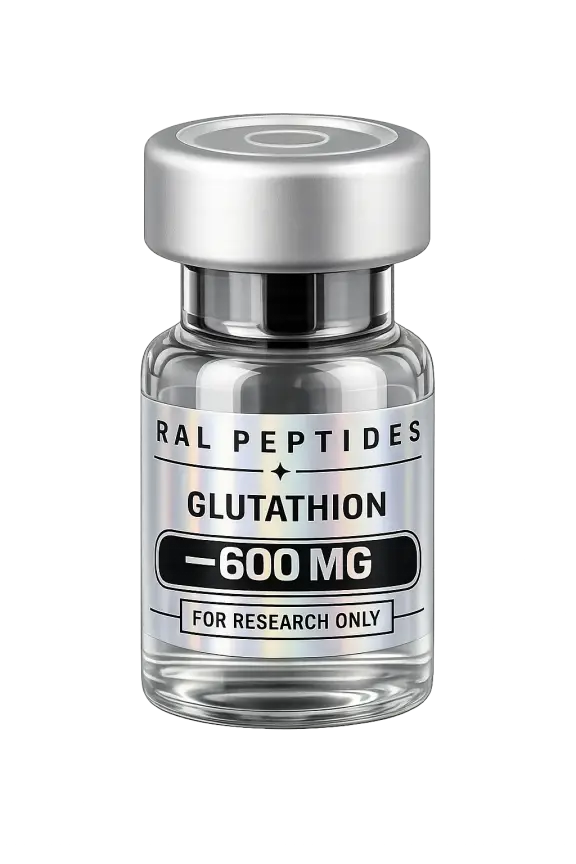
Chemical identity
- Sequence
- γ-Glu-Cys-Gly (liaison isopeptidique γ)
- Molecular formula
- C10H17N3O6S
- Molecular weight
- 307.32 g/mol
- CAS no.
- 70-18-8
Purity (HPLC) measures the absence of related impurities; it is distinct from net peptide content, since salts and counter-ions (acetate, TFA) count toward the vial mass. Account for this when computing the real concentration at reconstitution.
Potential benefits
Antioxidant defense
Neutralizes free radicals and reactive oxygen species, protecting cells from oxidative stress.
Liver detoxification
Supports hepatic conjugation and the elimination of certain toxins and metabolites.
Redox balance
Helps maintain the reduced/oxidized glutathione ratio, central to cellular homeostasis.
Skin radiance
Often associated with a more even, luminous complexion, linked to its action on oxidative stress.
Mechanism of action
- Reduced glutathione (GSH) donates an electron to neutralize free radicals and is converted into oxidized glutathione (GSSG).
- Glutathione peroxidase uses GSH to detoxify hydrogen peroxide and lipid hydroperoxides.
- Cofactor for glutathione S-transferases: conjugation of xenobiotics and toxins to facilitate their elimination (hepatic phase II).
- Regeneration of GSSG back into GSH by glutathione reductase, which is NADPH-dependent; recycling is ensured by the cellular redox cycle.
- Regenerates and is regenerated by other antioxidants (vitamin C, vitamin E) within the antioxidant network.
Historical milestones
Research milestones, clinical trials and regulatory steps.
- 1888
Discovery of "philothion"
French chemist de Rey-Pailhade identifies a reactive sulfur-containing substance in yeast, which he names philothion.
- 1921
Isolation by Hopkins
Frederick Gowland Hopkins extracts the compound from tissues, renames it glutathione and first describes it wrongly as a dipeptide.
- 1929
Tripeptide structure established
Hopkins re-examines the molecule and confirms it is a tripeptide of glutamate, cysteine and glycine.
- 1935
First chemical synthesis
Harington and Mead achieve the total synthesis of glutathione, definitively confirming its structure.
Evolution over time
Initial phase: supports the antioxidant load, with subjective effects varying between individuals.
Stabilization: some report a more luminous complexion and an improved sense of energy or recovery.
Maintenance: progressive effects on overall comfort; benefit depends on baseline oxidative status and lifestyle.
Dosages & protocol
Reference dosages
8 wk + 4 off
On an empty stomach in the morning (twice a week)
Injected glutathione has a very short plasma half-life (about 10-15 min IV in humans); the effect relies on sustaining the antioxidant network rather than prolonged presence.
Physiological role
Glutathione is present in virtually all cells and acts as the major intracellular antioxidant. Its level partly reflects the body's oxidative state and tends to decline with age, stress, and certain exposures.
Redox cycle and regeneration
- GSH (reduced) → GSSG (oxidized) during free radical neutralization.
- GSSG → GSH via glutathione reductase, NADPH-dependent.
- Close interaction with vitamin C, vitamin E, and NAC to maintain antioxidant capacity.
Signs to watch
- Positive: overall comfort, more luminous complexion, good local tolerance.
- To adjust: reactions at the injection site, digestive discomfort, skin rash.
Golden rule
Glutathione fits into an overall healthy lifestyle (sleep, diet, reduced oxidative exposure) rather than acting as a standalone solution. Informational content; not a substitute for medical advice.
Usage tips
- Combine with precursors (N-acetylcysteine) that supply cysteine, the rate-limiting amino acid for GSH synthesis.
- Vitamin C helps keep glutathione in its reduced (active) form.
- A sulfur-rich diet (cruciferous vegetables, garlic, eggs) supports endogenous production.
- Limit factors that deplete glutathione: alcohol, tobacco, chronic oxidative stress.
- Sleep and regular physical activity help maintain the antioxidant network.
- Keep a journal: how you feel, sleep, energy, skin condition.
Good to know / effects to watch
- Generally well tolerated; local reactions possible at the injection site (redness, tenderness).
- Transient bloating or digestive discomfort in some individuals.
- Rare skin or allergic reactions (itching, rash).
- Skin lightening may occur with prolonged use; its long-term safety remains poorly documented.
- Watch for (consult if severe/persistent): marked allergic reaction, widespread rash, breathing discomfort.
Storage
- Before reconstitution: lyophilized powder refrigerated (2-8 °C) or frozen (-20 °C), away from light and air.
- After reconstitution: keep refrigerated (2-8 °C), protected from light; use within a short window (reduced glutathione oxidizes readily).
- Avoid heat, light and freeze-thaw cycles; discard any yellowed or cloudy solution.
Contraindications
- Known hypersensitivity to reduced glutathione or an excipient.
- Pregnancy and breastfeeding (safety not established).
- Severe hepatic or renal impairment: safety not established, medical monitoring required.
- Asthma: rare bronchospastic reactions have been described, caution.
- Skin lightening with prolonged use: long-term safety poorly documented.
Possible synergistic combinations
Supplies cysteine, the rate-limiting amino acid, and promotes endogenous glutathione synthesis.
Helps regenerate glutathione into its reduced form and strengthens the antioxidant network.
An antioxidant that helps recycle glutathione and other antioxidants.
Sources & references
Links to external sources (scientific databases, trial registries, authorities). RAL Peptides is not responsible for their content.
⚠ For research use only. NOT intended for use on humans or animals. The values shown are indicative and for informational purposes ; each person reacts differently. This guide does not replace medical advice — consult a healthcare professional if in doubt.