Cagrilintide
Analogue de l'amyline (AM833)
Cagrilintide is a synthetic peptide designed to mimic the action of amylin, a hormone naturally secreted by the pancreas after meals. It plays a key role in regulating satiety and food intake. Developed to reproduce and prolong the effects of natural amylin with improved stability and a longer duration of action, it acts on the mechanisms of satiety and appetite control: faster satiety, prolonged fullness, reduced food cravings, and a spontaneous reduction in portion sizes. Unlike other multi-target peptides, it does not act on energy metabolism; its main role is to modulate the sensation of hunger and eating behavior.
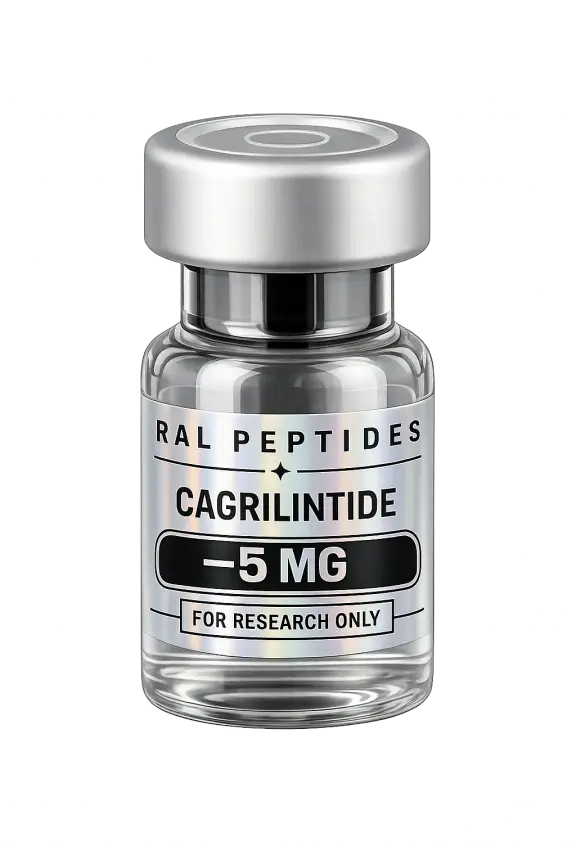
Chemical identity
- Sequence
- Analogue d'amyline, 37 résidus (pont disulfure Cys2-Cys7, acylation N-terminale C20)
- Molecular formula
- C194H312N54O59S2
- Molecular weight
- 4408.9 g/mol
- CAS no.
- 1415456-99-3
Purity (HPLC) measures the absence of related impurities; it is distinct from net peptide content, since salts and counter-ions (acetate, TFA) count toward the vial mass. Account for this when computing the real concentration at reconstitution.
Potential benefits
Faster satiety
A quicker drop in appetite after starting a meal.
Lasting satiety
Prolongs the feeling of fullness between meals.
Fewer cravings
Reduces "food noise" and food-related thoughts.
Controlled portions
Helps naturally eat smaller portions.
Better adherence
Makes it easier to stick to a consistent eating plan.
Mechanism of action
- Brain-level satiety: Cagrilintide acts on specific receptors in the brain involved in appetite regulation; the brain receives the message that energy needs are met more quickly (hypothalamus, the hunger control center).
- Gastric emptying: it slows gastric emptying, i.e. the time needed for the stomach to empty its contents, which extends satiety between meals and delays the return of hunger.
- Energy intake: by acting on satiety and gastric emptying, Cagrilintide naturally helps reduce food intake and makes it easier to maintain a caloric deficit.
Historical milestones
Research milestones, clinical trials and regulatory steps.
- Jun 2020
Phase 2 results
Novo Nordisk reports a phase 2 monotherapy trial (about 10.8% weight loss at 26 weeks) and a phase 1 combination trial with semaglutide.
- 2021
CagriSema proof of concept
Phase 1b data in The Lancet confirm an additive weight-loss effect of the cagrilintide + semaglutide combination.
- 2022
Phase 3 trials launch
The phase 3 REDEFINE program for the CagriSema combination begins in obesity and type 2 diabetes.
- 2025
REDEFINE 1 results
REDEFINE 1 shows 22.7% body-weight loss at 68 weeks, published in the NEJM.
- Dec 2025
FDA regulatory filing
CagriSema is submitted to the FDA for weight management based on the REDEFINE 1 and 2 trials.
Evolution over time
Reproduces amylin's action: sends satiety signals to the brain and slows gastric emptying.
Faster drop in appetite after starting a meal and more satisfying meals.
Prolonged satiety, less hunger, and reduced "food noise" and snacking.
Naturally reduced portions, maintenance of a caloric deficit, and better adherence to the eating plan.
Dosages & protocol
Reference dosages
12 wk + 4 off
One injection per week, on the same day, away from meals or before a meal
~7 to 8 days — compatible with a single weekly injection
Titration protocol
Stay on one step and let natural accumulation work. Progress slowly.
What is Cagrilintide?
An analogue of natural amylin, a hormone secreted by the pancreatic beta cells alongside insulin after a meal.
- Amylin acts by sending satiety signals to the brain and slowing gastric emptying.
- Cagrilintide reproduces and prolongs the effects of natural amylin with improved stability and a longer duration of action.
- Main action: acting on the mechanisms of satiety and appetite control.
- Faster satiety, prolonged satiety, reduced food cravings, spontaneous portion reduction, better stability between meals.
A targeted action on satiety signals
- Cagrilintide does not act on energy metabolism the way other multi-target peptides do.
- Its main role is to modulate the sensation of hunger and eating behavior.
Who might find Cagrilintide interesting?
It is not meant for everyone and is only relevant in a specific context where managing hunger is a genuine obstacle to reaching your goals.
- May be relevant: significant hunger despite a suitable protocol.
- May be relevant: difficulty managing portions (tendency to eat more than planned).
- May be relevant: frequent snacking between meals or in the evening.
- May be relevant: food-related thoughts that are constantly present.
- May be relevant: difficulty maintaining a caloric deficit consistently.
- Less relevant: diet already very well controlled.
- Less relevant: hunger is not the main issue (stress, sleep, activity).
- Less relevant: fatigue, lack of energy or motivation should be prioritized first.
- Less relevant: lack of physical activity.
- Less relevant: goal of accelerating weight loss alone (it is not a powerful metabolic tool like Retatrutide).
Cagrilintide vs Retatrutide
Cagrilintide: a satiety specialist, acting mainly on the sensation of hunger, satiety, food portions, and craving control. Retatrutide: a comprehensive metabolic approach, acting on appetite and satiety, energy metabolism, glucose management, energy expenditure, and multiple metabolic processes.
- In most cases, Retatrutide alone remains sufficient to act on both appetite and metabolism.
- Cagrilintide becomes relevant when hunger and satiety remain problematic despite a well-structured strategy.
Control starts with satiety
Cagrilintide is not a miracle solution. It is a specific tool that can be of interest when managing hunger becomes an obstacle to reaching your goals.
- A powerful but specialized tool: acts mainly on satiety signals and food control, does not replace a coherent nutritional strategy or a healthy lifestyle.
- The key: a comprehensive approach (suitable diet, physical activity, quality sleep); the best results come from balance and consistency over the long term.
- Listen to your body and adjust: everyone responds differently, gradual adjustment is essential for lasting results.
- The goal is not to eliminate hunger, the goal is to regain control.
- In conclusion: Cagrilintide can be an excellent ally when hunger and food cravings are the main obstacle; used in a targeted way and paired with a comprehensive strategy, it can make a real difference.
Usage tips
- Cagrilintide does not make calories disappear: it helps better manage hunger and portions to maintain a reasonable caloric deficit.
- Before adding Cagrilintide, ask yourself: "Is hunger really my main problem?"
- It does not replace a coherent nutritional strategy or a healthy lifestyle.
- Combine with a suitable diet, physical activity, and quality sleep: no peptide replaces the fundamentals.
- Everyone responds differently: listen to how you feel and adjust gradually for lasting results while protecting your health.
- Consistency, patience, and lifestyle habits remain the pillars of any progress.
Good to know / effects to watch
- Slowed gastric emptying, which can cause digestive discomfort
- Sensations linked to a strong reduction in appetite
- Effects to monitor by paying attention to how you feel and adjusting the dose gradually
Storage
- Before reconstitution (lyophilized powder): refrigerated (2-8 °C), away from light; tolerates short periods at room temperature during shipping.
- After reconstitution: refrigerated (2-8 °C), typically use within ~4 weeks (28 days).
- Do not freeze, do not shake vigorously, avoid heat and direct light.
Contraindications
- Pregnancy and breastfeeding: avoid.
- History of gastroparesis or severe GI disorder: caution (delayed gastric emptying may be increased).
- Interactions: increased hypoglycemia risk when combined with insulin or sulfonylureas.
- Known hypersensitivity to cagrilintide or any excipient.
- Experimental amylin analog: human use not approved, limited long-term safety data.
Possible synergistic combinations
The catalog peptides are clickable — to complete or optimize your protocol.
Sources & references
Links to external sources (scientific databases, trial registries, authorities). RAL Peptides is not responsible for their content.
⚠ For research use only. NOT intended for use on humans or animals. The values shown are indicative and for informational purposes ; each person reacts differently. This guide does not replace medical advice — consult a healthcare professional if in doubt.