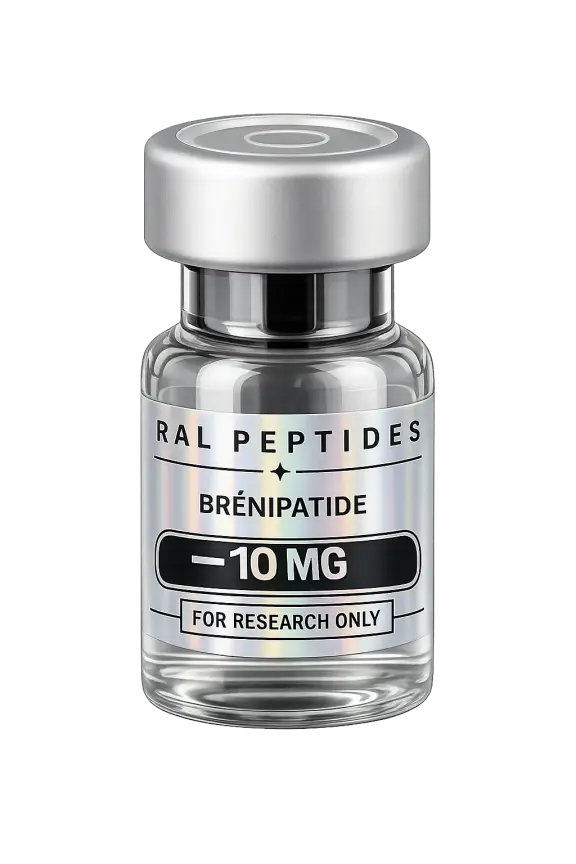
Brénipatide
LY-3537031 · Co-agoniste des récepteurs GIP / GLP-1 (longue durée d'action)
Brenipatide (development code LY-3537031) is described in the literature as a co-agonist of the GIP and GLP-1 receptors, two incretin hormones involved in regulating blood glucose and appetite. Its reported distinguishing feature is a very long duration of action, studied for monthly administration. It is an experimental compound (preclinical and clinical research ongoing): the information below is provided for documentary and research purposes only, with no validation or recommendation for human use.
Chemical identity
- Molecular formula
- C228H354N46O72
- Molecular weight
- 4891.52 g/mol
- CAS no.
- 2408921-49-1
Purity (HPLC) measures the absence of related impurities; it is distinct from net peptide content, since salts and counter-ions (acetate, TFA) count toward the vial mass. Account for this when computing the real concentration at reconstitution.
Potential benefits
Dual incretin pathway
Studied as a GIP + GLP-1 co-agonist, a receptor combination associated in research with the regulation of blood glucose and appetite.
Extended duration of action
Designed for a very long half-life: the research presents it as a candidate for spaced-out (monthly) rather than weekly administration.
Satiety signals
The GLP-1 pathway is studied for its action on satiety centers and the slowing of gastric emptying.
Glucose-dependent insulin response
The GIP/GLP-1 component is associated in research with insulin secretion modulated by blood glucose levels.
Spacing convenience
A long interval between administrations could, in a research context, reduce the frequency of handling compared with weekly incretins.
Exploratory metabolic profile
Positioned among next-generation incretins, it is explored for body composition and energy metabolism.
Mechanism of action
- GLP-1: the pathway is studied for activating central satiety signals, inhibiting hunger signals, and slowing gastric emptying.
- GIP: the second incretin component is associated in research with strengthening the glucose-dependent insulin response and modulating lipid metabolism.
- GIP + GLP-1 co-activation is explored for a synergy on glycemic control and appetite superior to a GLP-1 agonist alone.
- Structural modification of the peptide backbone described to greatly extend the half-life and allow monthly spacing of administrations.
- Glucose-dependent insulin secretion: the action is described as modulating according to blood glucose levels, a point studied to limit hypoglycemic risk.
Historical milestones
Research milestones, clinical trials and regulatory steps.
- 2023
Entry into clinical development
Eli Lilly advances brenipatide (LY-3537031), a GIP/GLP-1 co-agonist engineered for monthly subcutaneous dosing.
- 2024
Phase 3 trials launched
Lilly evaluates brenipatide in phase 3, notably for alcohol use disorder and bipolar disorder.
- 2026
Ongoing program
Studies continue in obesity, asthma and smoking cessation, with no phase 2/3 results yet published.
Evolution over time
Low-dose start: first exposure, observation of digestive tolerance.
Monthly spacing: gradual increase according to tolerance, exposure accumulating due to the long half-life.
Steady state reached after several administrations at a constant dose; regular monitoring of parameters.
Dosages & protocol
Reference dosages
16 wk
1×/month — roughly one monthly administration (peptide described as very long-acting)
Very long, described as longer than tirzepatide and retatrutide — studied for once-monthly administration.
Titration protocol
Stay on one step and let natural accumulation work. Progress slowly.
Experimental status
Brenipatide (LY-3537031) is a research compound described as a very long-acting GIP/GLP-1 co-agonist. It is neither approved nor intended for human use outside a controlled research setting. The dosing parameters given here are cautious documentary reference points, not recommendations: they are not based on consolidated public clinical results.
Accumulation logic
The described very long half-life implies a gradual accumulation of exposure over several weeks. Any progression must be slow and spaced out, with each step assessed for tolerance before considering the next; an effect, positive or adverse, may persist long after administration.
Recommended dilution (10 mg vial, U-100 syringe)
- 1 ml of BAC → 10 mg/ml: each unit (0.01 ml) delivers 0.1 mg (100 mcg).
- 2 ml of BAC → 5 mg/ml: each unit delivers 0.05 mg (50 mcg).
- Example: to draw 4 mg at 10 mg/ml, draw 0.4 ml, i.e. 40 units on a U-100 syringe.
- Adjust the BAC volume for ease of drawing based on the target dose, keeping a concentration that is easy to measure.
Usage tips
- Consider this compound strictly experimental: no validated human use, reserved for research.
- Progress very slowly: given the long half-life, any adjustment takes weeks to be fully reflected.
- Precisely document each administration (date, dose, volume): monthly spacing makes written tracking essential.
- Pay attention to hydration and electrolytes (sodium, potassium, magnesium), sensitive points for the incretin class.
- Store the reconstituted vial in the refrigerator and follow aseptic technique when drawing doses.
Good to know / effects to watch
- Digestive effects such as nausea are, for the incretin class, the most frequently reported, especially at the start or after a dose increase.
- Diarrhea or constipation, bloating, early satiety may be observed within this class.
- Headaches, transient fatigue, marked loss of appetite are described for incretin agonists.
- Brenipatide's own safety profile is not established: experimental compound, limited and non-consolidated human data.
- To consider with caution: the very long duration of action means an adverse effect could persist long after administration.
- To monitor for the class (warning signs): repeated vomiting, intense abdominal pain, signs suggestive of pancreatitis, hypoglycemia.
Storage
- Before reconstitution (lyophilized powder): refrigerated (2-8 °C), away from light; tolerates short periods at room temperature during shipping.
- After reconstitution: refrigerated (2-8 °C), use within ~4 weeks (28 days); maintain strict aseptic technique when drawing.
- Do not freeze, do not shake vigorously, avoid heat and direct light.
Contraindications
- Pregnancy and breastfeeding: avoid.
- Personal or family history of medullary thyroid carcinoma (MTC) or MEN 2: class contraindication (incretin co-agonists).
- History of pancreatitis; severe GI disorders: caution.
- Interactions: hypoglycemia risk with insulin or sulfonylureas; the very long half-life means an adverse effect may persist long after dosing.
- Strictly experimental compound (LY-3537031): no validated human use, specific safety profile not established.
Possible synergistic combinations
Sodium, potassium, magnesium — often paired with the incretin class to limit fatigue, cramps, and headaches.
Adequate protein intake, studied to preserve lean mass in a context of reduced appetite.
Regular measurements (weight, waist circumference, blood glucose) to track progress objectively rather than relying on how you feel.
Sources & references
Links to external sources (scientific databases, trial registries, authorities). RAL Peptides is not responsible for their content.
⚠ For research use only. NOT intended for use on humans or animals. The values shown are indicative and for informational purposes ; each person reacts differently. This guide does not replace medical advice — consult a healthcare professional if in doubt.