BPC-157 / TB-500
Blend réparation & récupération (BPC-157 + fragment de Thymosine Bêta-4)
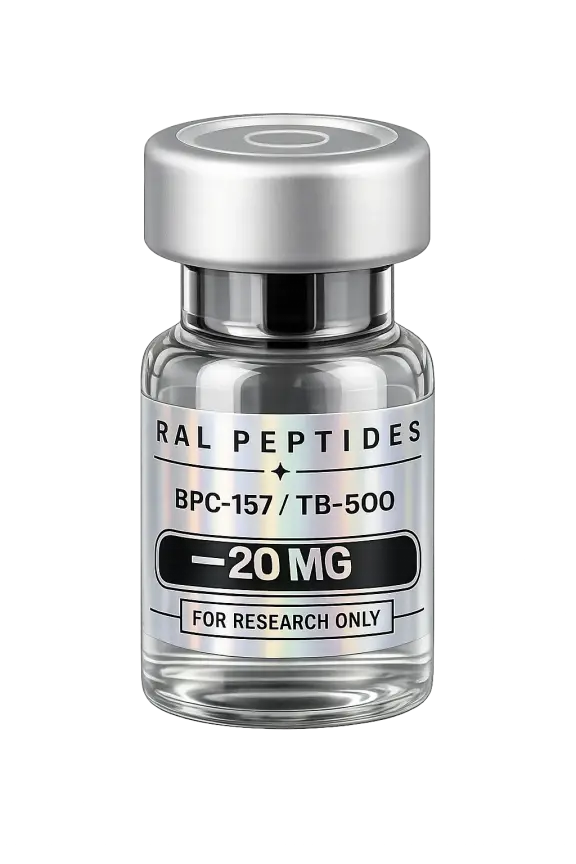
This blend combines BPC-157 and TB-500 (a synthetic fragment of Thymosin Beta-4) in a single vial — two of the most studied and reputedly complementary recovery peptides. BPC-157 targets localized tissue protection and repair (tendons, ligaments, digestive lining), while TB-500 promotes cell migration and more systemic regeneration. Together they are sought after to accelerate recovery after injury and support tissue repair. The 20 mg vial contains a 1:1 blend (roughly 10 mg of each peptide).
Potential benefits
Repair synergy
Combines the localized repair of BPC-157 with the systemic regeneration of TB-500.
Accelerated recovery
Supports faster recovery after injury, intense effort, or a procedure.
Anti-inflammatory
Helps reduce inflammation and discomfort associated with tissue damage.
Tendons & ligaments
Particularly targets the health of tendons, ligaments, and joints.
Mobility
May improve mobility and flexibility over the course of the protocol.
Convenience
One vial, one injection for two complementary peptides.
Mechanism of action
- BPC-157: cytoprotection and localized tissue repair, supporting the digestive lining and tendon/ligament regeneration.
- TB-500: promotes migration of repair cells (fibroblasts, endothelial cells) toward damaged areas.
- Angiogenesis: both peptides support the formation of new vessels and better tissue vascularization.
- Inflammation modulation: reduces inflammatory signaling to speed up resolution.
- Complementary action: "targeted" repair (BPC-157) and "systemic" regeneration (TB-500) in a single administration.
Evolution over time
Reduced inflammation and pain, a sense of improved mobility.
Visible onset of tissue repair and functional recovery.
More pronounced tissue regeneration, reduced pain, and improved mobility.
Consolidation of repaired tissue and greater resilience to injury.
Dosages & protocol
Reference dosages
6 wk + 4 off
1 injection per day, preferably after training or before bedtime
Varies by component: BPC-157 has a short plasma half-life (a few minutes to ~1-2 h); TB-500 has a plasma half-life of a few hours with prolonged tissue retention (several days), allowing less frequent injections.
Why a BPC-157 / TB-500 blend?
The two peptides act on complementary repair pathways. Combining them in a single vial simplifies the protocol while covering both localized repair and systemic regeneration.
- BPC-157: targeted repair (tendons, ligaments, gut), cellular protection.
- TB-500: cell migration and broader tissue regeneration.
- Ideal for severe injuries, post-effort recovery, and post-surgical support.
Recommended dilution (20 mg 1:1 vial, U-100 syringe)
- 4 ml of BAC → 5 mg/ml of blend (roughly ~2.5 mg/ml of each peptide) → 50 mcg of each per unit.
- 2 ml of BAC → 10 mg/ml of blend → reduced injection volume for the same dose.
- Example: 0.5 mg of blend at 5 mg/ml = 10 units on a U-100 syringe.
- Adjust the BAC volume based on draw comfort and the targeted dose.
Usage tips
- Always use bacteriostatic water (BAC); gently swirl the vial without shaking it.
- Rotate injection sites to avoid local irritation.
- Start with the lowest dose and adjust according to response.
- Store refrigerated (2 – 8 °C), do not freeze; use within 28 days after reconstitution.
- Combine with quality sleep, hydration, and an anti-inflammatory diet to maximize results.
Good to know / effects to watch
- Redness or mild irritation at the injection site.
- Mild headaches or transient fatigue at the start of the protocol.
- Nausea (rare).
- Blend generally well tolerated; effects are rare and temporary.
- Pregnancy, breastfeeding, or a pre-existing condition: seek medical advice.
Storage
- Before reconstitution: lyophilized powder refrigerated (2-8 °C), protected from light.
- After reconstitution (bacteriostatic water): refrigerate (2-8 °C), protect from light; use within ~28 days.
- Do not freeze; swirl the vial gently, do not shake.
Contraindications
- Pregnancy and breastfeeding.
- Active cancer or history of cancer (angiogenesis / tissue proliferation).
- Known hypersensitivity to BPC-157, TB-500 or an excipient.
- Pre-existing medical condition: seek medical advice before use.
Possible synergistic combinations
The catalog peptides are clickable — to complete or optimize your protocol.
Wound healing, skin, and tendons; complements the blend's repair action.
View the sheet & add →Recovery, tissue growth, and sleep — anti-aging and athletic synergy.
View the sheet & add →Support collagen synthesis and the quality of tendons and skin.
Sources & references
Links to external sources (scientific databases, trial registries, authorities). RAL Peptides is not responsible for their content.
⚠ For research use only. NOT intended for use on humans or animals. The values shown are indicative and for informational purposes ; each person reacts differently. This guide does not replace medical advice — consult a healthcare professional if in doubt.